
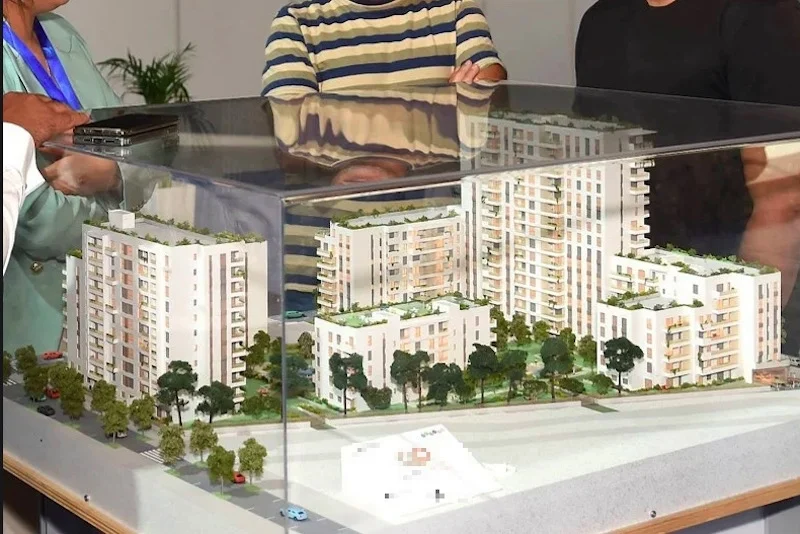
For a growing number of middle-class Moroccans, buying a home is starting to feel less like a milestone and more like an obstacle course. Prices keep climbing, salaries don’t, and even a state subsidy program is struggling to catch up with demand. That’s the portrait of the Moroccan property market painted by a recent report from Moroccan outlet Hespress, drawing on official data and industry voices.
Fewer sales, higher prices
The clearest sign that something is off in the market is a striking paradox: real estate transactions fell by more than 40 percent in the first quarter of this year, yet prices continued their upward march and hit record levels, according to figures from Bank Al-Maghrib and the National Agency for Land Registry, Cadastre and Cartography (ANCFCC).
The pressure is felt hardest in the big cities. Families are running into the twin walls of stubbornly high borrowing costs — mortgage interest rates currently range between 4.10 and 5.20 percent, before taxes and insurance, though certain groups benefit from interest-free loans through social-works institutions — and a chronic shortage of supply relative to a swelling demand for well-located homes near workplaces and basic urban services.
The state steps in — and hits its limits
Under the current government, Morocco launched a direct housing-purchase subsidy scheme designed to help first-time buyers. It provides financial support of around 100,000 dirhams for apartments priced at up to 300,000 dirhams, and 70,000 dirhams for apartments under 700,000 dirhams — a break from the previous “economic housing” system, which guaranteed apartments at 250,000 dirhams.
The demand has been enormous. As of early June, the Secretariat of State for Housing had received 218,877 applications nationwide since the program’s launch, targeting the 2024–2028 period. Only 105,027 applicants had been served. Moroccans living abroad accounted for 24 percent of beneficiaries, women for 47.5 percent, and young people under 40 for 52 percent. Sixty percent of recipients received the 70,000-dirham tranche, and the remainder the 100,000-dirham one.
“A rational option: buying used”
For Amine Marnissi, a real estate expert quoted by Hespress, the root of the crisis lies upstream. The sector is being squeezed by the rising cost of inputs — first and foremost, land itself. While the current subsidy program has offered citizens some breathing room, he argues, the property supply on offer is simply not enough to meet demand, especially in the big cities, where the economics prevent developers from taking on unprofitable projects.
Without coordination between the state and the private sector, Marnissi says, matching the volume of demand is nearly impossible — and the gap between the more than 200,000 applications for the subsidy program and the roughly 105,000 files served illustrates the point. In Casablanca or Rabat, he adds, finding a suitable home with a financing ceiling of 300,000 dirhams is difficult if not outright impossible. Apartments in the 300,000–700,000 dirham range exist in other cities, but availability varies widely.
Most developers, Marnissi notes, prefer to focus on luxury property — where profit margins are higher and demand is robust. His counterintuitive advice for the middle class: consider the second-hand market. Older properties in established neighborhoods with functioning services are, in his view, often a more rational choice than chasing new apartments in the outskirts.
He also stresses that Morocco’s real estate sector has only truly matured over the last three decades, moving from individual contractors to large organized development companies. The old “economic housing” program, he adds, did play a real role in energizing the sector.
The Rabat price tag
The numbers from the capital tell their own story. In 2025 and 2026, residential prices in Rabat ranged from 8,500 to 25,000 dirhams per square meter for apartments, from 16,000 to 32,000 dirhams for villas, and from 9,000 to 18,000 dirhams for commercial premises. According to specialized real estate portal Massakine, the average price of a Rabat apartment sits between 12,000 and 14,500 dirhams per square meter, varying with neighborhood and finish. Agdal, Hay Riad, and Souissi rank among the most expensive districts, while Yacoub El Mansour and Taqaddoum remain relatively more affordable.
Casablanca, Tangier, Marrakech, and Agadir are heading in the same direction, with strong demand for private apartments meeting limited supply — and a growing appetite for studios that can be converted into short-term rentals on platforms like Airbnb.
A “complex and deep” crisis
A source inside the National Federation of Real Estate Developers (FNIP) acknowledged that the sector is grappling with a complex, deep-rooted crisis caused by a combination of economic, social, and administrative factors that have thrown supply and demand out of balance.
Wages for large segments of the Moroccan population have remained flat for years, the source told Hespress, sharply eroding purchasing power and the ability to save toward a home. On the developer side, the final sale prices of new apartments have been pushed up by an inflation wave: land, building materials such as cement, steel, and aluminum, and the wages of workers and craftsmen have all become more expensive, with no meaningful improvement since the Covid-19 pandemic.
Mid-range apartments now start at 700,000 dirhams in some cities, the source said. Middle-class buyers who want to stay within reach are increasingly pushed to the outskirts of urban areas; inside the cities themselves, the matter has effectively been settled for some time.
Developers, meanwhile, face lengthy and complex administrative procedures involving urban agencies, local authorities, and various permitting bodies — a maze that slows down project delivery. The current property crisis, the federation source concluded, is the product of a complicated economic equation, where rising input costs and administrative fees have driven up the final price of the product just as citizens’ purchasing power has fallen. Unblocking the market, in their view, will require a comprehensive rethink and genuine intervention from every stakeholder involved.
For now, Morocco’s middle class is left with a bruising math problem — and the growing sense that the front door to a home of their own is closing faster than they can reach it.