

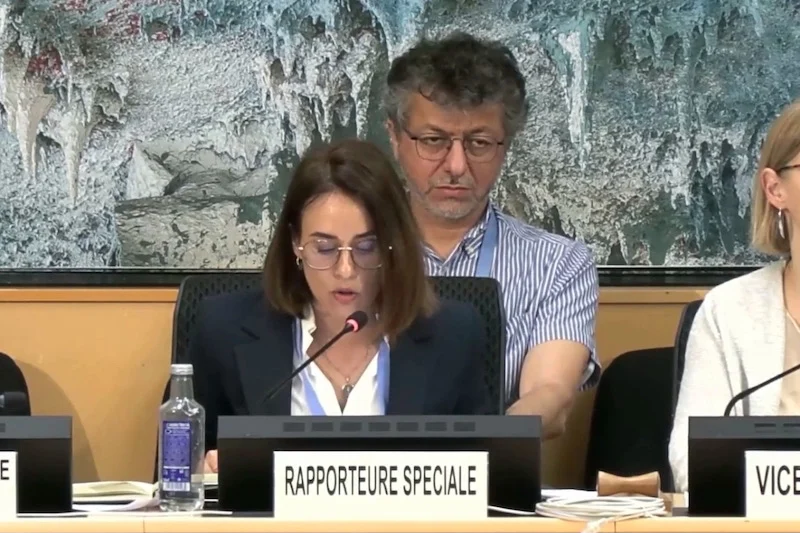
GENEVA — The UN Special Rapporteur on extreme poverty and human rights, Elena Carolina Díaz Galán, has praised Morocco’s efforts to combat poverty, singling out the Kingdom’s flagship development and human-development programs during an interactive dialogue at the 62nd session of the Human Rights Council.
Speaking to the Council, Díaz Galán pointed to Morocco’s New Development Model, noting that it was drawn up through a participatory approach in which roughly 10,000 people contributed to identifying national priorities. She also highlighted the National Initiative for Human Development, launched in 2005, as among the initiatives the country has adopted in the fields of human development and poverty reduction.
The remarks carry particular significance given the report under discussion. Díaz Galán, a Spanish professor of international law at Rey Juan Carlos University, is the newly appointed mandate holder: she was named Special Rapporteur on extreme poverty and human rights by the Human Rights Council at its 61st session in March 2026, succeeding Belgium’s Olivier De Schutter. At this session, she was presenting the report of the former mandate holder, De Schutter, to the Council — meaning Morocco’s mention came in the context of a body of work she inherited rather than authored.
That context explains why Morocco surfaced as an example. The De Schutter report and its accompanying “Roadmap for Eradicating Poverty Beyond Growth” argue for a shift away from purely growth-centered strategies toward anti-poverty policies shaped by the people they are meant to serve. The report stresses the transformative potential of national anti-poverty strategies developed through genuine participatory processes, on the premise that when people experiencing poverty help define priorities, policies become better aligned with actual needs. Morocco’s New Development Model — a long-term strategic blueprint commissioned by King Mohammed VI and delivered by a special commission in 2021 after wide-ranging consultations — fits that argument closely, which is likely why it was cited.
The National Initiative for Human Development (INDH), launched by the King in 2005, remains Morocco’s signature anti-poverty program, focused on reducing social deficits, supporting income-generating activities, and targeting vulnerable communities. It has run through successive phases and is frequently invoked by Moroccan authorities in international forums.
The exchange formed part of the interactive dialogue with the Special Rapporteur held during the Council’s 62nd session, which runs in Geneva from 15 June to 7 July 2026. The dialogue offered an occasion to debate approaches for strengthening anti-poverty efforts and advancing comprehensive public policies built on the involvement of the various stakeholders concerned.
A favourable reference of this kind, however, is a narrow slice of a broader picture. UN human rights bodies and independent organizations have also raised concerns about poverty, inequality, and the realization of social rights in Morocco — so the rapporteur’s nod to specific Moroccan initiatives reflects their alignment with a participatory-policy argument rather than a comprehensive endorsement of the country’s overall record.