

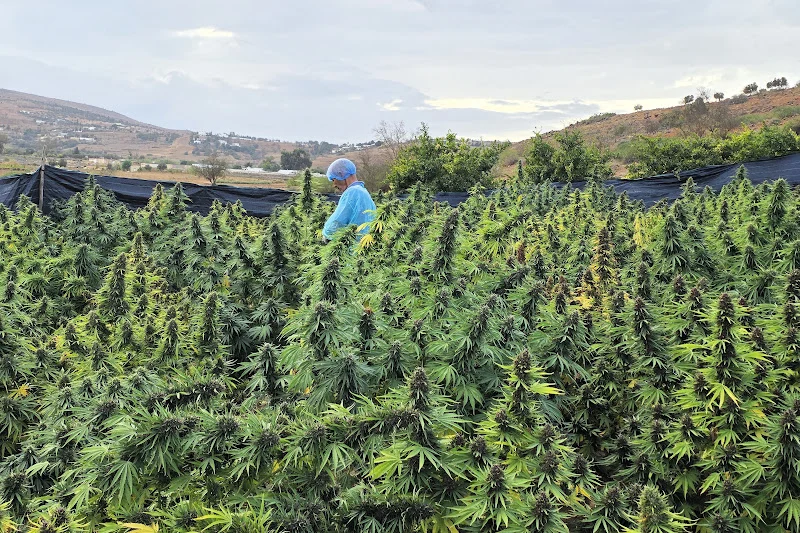
RABAT — Cannabis farmers in Morocco have wrapped up planting the third season of the “Beldia” variety, the indigenous local strain the Kingdom is banking on within a legal framework geared primarily toward the medical and pharmaceutical industries. The harvest caps a process that began in March 2021, when Morocco adopted Law 13-21 and became one of the first African countries to permit cannabis for medical, pharmaceutical and industrial use — a reform pitched as a way to steer cultivation in the historically cannabis-growing northern Rif away from the illicit market and toward a regulated chain meant to raise farmers’ incomes and create stable jobs.
Yet the success of that chain depends not only on expanding cultivated areas or raising output, but on the market’s ability to move finished products through approved legal channels, many of which require a medical prescription before sale. Morocco’s ambition is an integrated economic model linking farmers, manufacturers and distributors, and each link is tied to the next: if approved pharmaceutical products go unsold, the effect is felt directly on the pace of manufacturing, and in turn on demand for the crops grown by licensed farmers.
The area planted with “Beldia” this season reached roughly 2,200 hectares, a slight decline from last season’s 2,600 hectares, while the area harvested in 2024 stood at around 2,000. Officials are careful to frame the dip not as waning interest but as a consequence of reorganizing the sector and tightening oversight. The “Beldia” strain itself — the country’s native landrace, as opposed to imported high-THC hybrids — continues to consolidate its place in the new system, favored both for agronomic and heritage reasons and because steering farmers toward a domestically rooted, regulated crop is central to the legalization narrative.
That tightening has been visible on the ground. Roughly 1,300 license-withdrawal warnings were issued in the recent period to nearly 1,200 farmers after monitoring revealed irregularities tied to non-compliance with legal conditions and procedures, and more than half of those warnings are likely to become final revocations if beneficiaries fail to regularize their situations. Oversight extended to economic operators as well, with around 150 warnings issued to 85 firms across the production, processing and marketing chains. The measures followed a comprehensive assessment carried out at the end of 2025 covering farmers, cooperatives and licensed companies alike, whose findings the authorities used to gauge compliance before issuing warnings or revoking permits.
Observers read the move as the legalization process entering a new phase — shifting from broadening the base of beneficiaries toward entrenching governance and legal compliance, a step meant to secure the project’s credibility at home and abroad. That reading fits the wider trajectory of the sector overseen by the National Agency for the Regulation of Cannabis-Related Activities (ANRAC), the sole licensing authority, established in 2022 under the Interior Ministry and led since that year by Mohammed El Guerrouj. Even as the “Beldia” planted area dipped, the industry overall has grown: ANRAC has reported production of close to 2,000 tonnes of dried cannabis in 2025, up about 10 percent year-on-year, with active licenses climbing to 5,765 for the season, of which 5,492 were cultivation permits benefiting some 5,318 farmers.
Speaking in Casablanca on Saturday, El Guerrouj said Morocco now has a ready legal framework and an available, regulated offering in medical cannabis, and stressed that the project’s long-term success rests on a delicate but essential balance — reconciling the mandatory public-health requirements governing prescription with the growth opportunities and sustainable economic benefits that operators and smallholder farmers need to stay in business. He said more than 110 cannabis-based products had been manufactured and registered with the Moroccan Agency for Medicines and Health Products (AMMPS) and were available in over 600 approved outlets, a tally that has continued to climb; in later statements he put the figure at more than 140 registered products.
That dependence on the demand end is the venture’s central vulnerability, and El Guerrouj framed it bluntly: “If these products are not dispensed by prescription, they will not be sold. If they are not sold, manufacturers will stop producing them. And if the factories close, companies will stop buying crops from smallholder farmers.” Because most finished products require a prescription, uptake hinges on doctors actually prescribing them — which is why ANRAC and the medical community have lately pushed for clinical guidelines, a national list of therapeutic indications and physician training. Until that prescribing culture matures, the risk he describes remains live: unsold inventory cascading back into reduced manufacturing and weaker demand for the very crops Moroccan farmers have just finished planting.
The figures underpinning that outlook come largely from ANRAC itself, and reflect official data that independent analysts have not always been able to verify directly.