


Morocco’s banking sector had a strong 2025 — credit grew, profits rose, and capital buffers stayed comfortable. But the headline from Bank Al-Maghrib’s annual banking supervision report wasn’t the good news. It was the penalties: fifteen sanctions handed down to banks and credit institutions, and a pledge to start naming offenders publicly, according to Moroccan outlet Hespress.
A healthy sector on paper
The report describes a banking landscape still dominated by private Moroccan capital, which controls roughly 73 percent of market share among conventional banks — far ahead of majority state-owned banks (22 percent) and majority foreign-owned banks (under 5 percent).
The sector now counts 95 institutions, up from 92 a year earlier. Outstanding customer loans exceeded 1,238 billion dirhams, up more than 6.5 percent and driven largely by equipment lending, while deposits grew close to 8 percent, supported mainly by current accounts.
Profitability improved as well: net banking income reached about 74 billion dirhams on an individual basis, net profit topped 19 billion dirhams, and the cost of risk fell noticeably. Prudential ratios remained comfortable, with an average solvency ratio of 16.1 percent — well above the 12 percent regulatory minimum.
Fifteen sanctions — and corrective homework
The enforcement chapter drew particular attention at the press conference presenting the report. On-site inspections carried out during 2025 resulted in fifteen sanctions: seven disciplinary and eight financial.
The inspections covered a wide sweep of risk-management territory — governance frameworks, cybersecurity risk controls, asset quality, customer-relations practices (tested through “mystery shopping” missions), anti-money-laundering and counter-terrorism-financing systems, credit-granting and factoring operations, accounting systems, and internal controls.
Six banks, one finance company, one payment institution, and one microcredit institution were inspected. Beyond the sanctions themselves, the central bank required the institutions concerned to adopt corrective action plans — extending its role from punishing violations to steering offenders back into compliance.
License withdrawal: the nuclear option
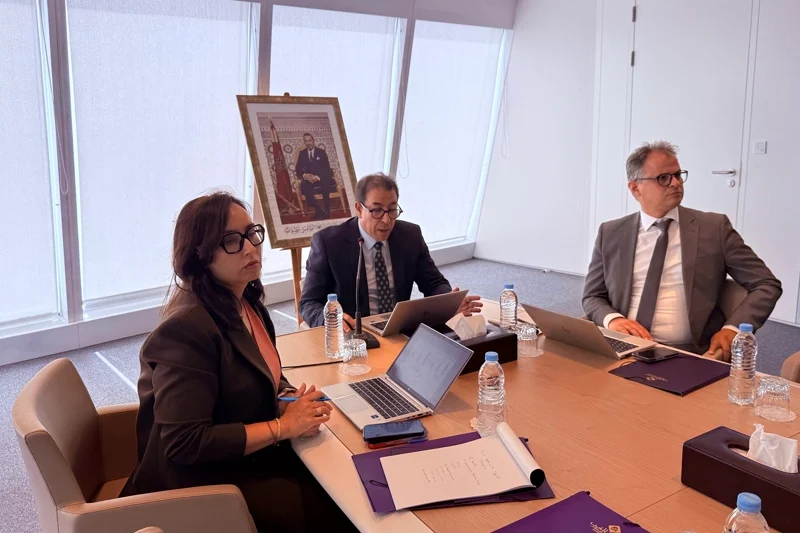
Nabil Badr, head of banking supervision at Bank Al-Maghrib, told the press conference that withdrawing a license is the harshest disciplinary measure available against credit or microfinance institutions — and one taken only after a full legal procedure guaranteeing the right of defense.
Cases are examined by a disciplinary committee chaired by the central bank’s director general and including representatives of the Ministry of Economy and Finance, the central bank, and two judges. The committee proposes sanctions, which are then submitted to the bank’s governor for final approval. A license withdrawal automatically triggers liquidation proceedings and the appointment of a liquidator.
Short of that, the toolkit includes warnings, compliance orders, reprimands, and fines — the proceeds of which go to the state treasury as public debt. Fine amounts are set according to precise criteria, including the gravity of the breach, repeat offenses, the nature of the failing, and how quickly it is corrected. Under a central bank circular, penalties can range from 20,000 dirhams to 20 percent of the institution’s capital.
Notably, Badr said the bank is now working to publish disciplinary sanctions — starting with professional penalties — and to inform the public about the institutions involved, a transparency push meant to strengthen confidence in the supervisory system.
Bigger reforms in the pipeline
The enforcement drive sits within a broader compliance agenda. The report highlights intensified risk-based monitoring of money-laundering and terrorism-financing controls ahead of Morocco’s mutual evaluation by the MENA Financial Action Task Force (MENAFATF), whose procedure formally began on November 27, 2025. On the cyber front, the bank has rolled out a cybersecurity dashboard across all banks and completed a good-practices guide for countering ransomware attacks.
Structural reforms completed in 2025–2026 will further widen the supervisor’s room for maneuver. A reform of loan classification and provisioning introduces a new category of “sensitive debts,” designed to flag credit risk before actual default occurs. And a landmark overhaul of the banking law’s resolution regime — finally adopted by the House of Councillors on June 30, 2026 — gives the central bank formal resolution powers and creates a resolution board, chaired by the governor, to examine institutions’ preventive resolution plans.
The bank also continued monitoring commitments made by the Interbank Monetary Center (CMI) as part of opening the payments market to competition, notably the reduction of interchange fees from 0.65 percent to 0.50 percent starting in July 2026.
Customers are complaining — a lot more
One striking data point closes the report: customer complaints handled by Bank Al-Maghrib jumped from 1,459 in 2023 to 3,591 in 2025 — a rise of more than 56 percent in the last year alone, mostly concerning account management and payment methods. The Moroccan Center for Banking Mediation saw a parallel trend, with cases processed up more than 31 percent in 2025.