
France and Morocco have taken a concrete step toward one of the most ambitious energy projects in the Mediterranean: a direct electricity interconnection that would carry Moroccan clean power straight to French shores — bypassing Spain entirely.
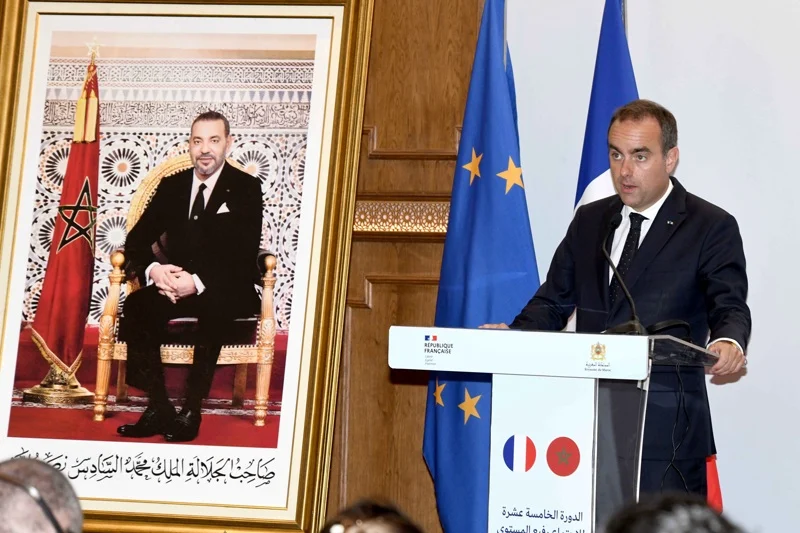
Speaking at a press conference on Thursday at the close of the 15th Morocco–France High-Level Meeting in Rabat, French Prime Minister Sébastien Lecornu announced the launch of a call for expressions of interest in the interconnection project, describing it as one of several ambitious economic ventures designed to integrate the two countries into shared value chains, according to Moroccan outlet Hespress. He also pointed to strategic investments by major French companies and initiatives by small and medium-sized enterprises across Morocco in sectors including transport, energy, and advanced technologies.
The “Mediterranean Bridge”
Dubbed the “Mediterranean Bridge,” the project aims to transmit clean electricity generated in northern Morocco directly to French and European markets in support of decarbonization goals. Both governments see it as a flagship undertaking — one that would strengthen energy sovereignty and deepen structural ties between Rabat and Paris, despite technical challenges related to the transmission route and manufacturing costs.
For France, the link would offer a flexible answer to global energy pressures and accelerating climate transitions, allowing Paris to manage its supply chains without depending on the infrastructure of other European countries. For Morocco, it is a chance to convert its natural renewable-energy advantages into a strategic asset — positioning the kingdom as an energy platform capable of attracting high-value investment and feeding power into the heart of the European market.
Marseille’s new role — and a pointed message to Madrid
An analysis by French firm Selectra argues that Marseille, which has significantly reinforced its position as a logistics hub in recent years, is set to become the key entry point for African green energy into Western Europe.
The proposed route, Selectra notes, breaks with the historical logic of cross-Mediterranean interconnections. Until now, the Iberian Peninsula has served as the natural bridge for electricity flowing between North Africa and the rest of the continent. A direct submarine cable would free the project’s backers from the geographic and political constraints of the Pyrenees — long a bottleneck for power exchanges between Spain and France.
Under this scenario, Marseille would no longer be merely a cargo port but a major node in southern France’s electricity grid, capable of absorbing gigawatt-hours of power without transiting the Iberian Peninsula. French involvement, the analysis suggests, may reflect Paris’s desire for direct control over the valves of future energy supply, without relying on the pricing policies or infrastructure hurdles of its immediate neighbor, Spain.
Morocco, Selectra concludes, is no longer a simple trading partner but a new actor in Europe’s decarbonization — armed with massive solar and wind investments and production costs that defy European competition. The analysis ends on a striking note: the energy of the future will not necessarily follow the shortest routes, but those offering the greatest geopolitical independence.
Groundwork already laid
The announcement builds on ongoing bilateral work. In April of last year, Leila Benali, Morocco’s Minister of Energy Transition and Sustainable Development, met with senior French officials — including Gérard Mestrallet, special envoy of President Emmanuel Macron, and the CEO of France’s electricity transmission operator RTE — to review progress on the technical and economic studies underpinning the project.
Participants at that meeting stressed the importance of close cooperation and a smooth, transparent exchange of technical data between the relevant institutions in order to accelerate the project’s implementation.