



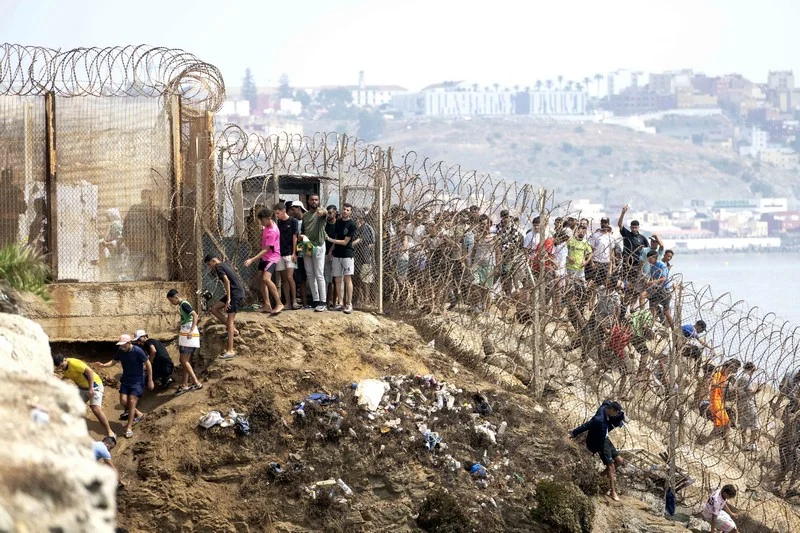
Morocco has pushed back sharply against suggestions that it failed to stop the mass migration surge into Ceuta last month — instead placing the blame squarely on a ruling by Spain’s own Supreme Court. A Moroccan government source, quoted by state news agency MAP and relayed by Moroccan outlet Hespress, argued Monday in Rabat that a Spanish judge cannot dismantle the anti-irregular-migration architecture and then expect the kingdom to shoulder the consequences.
Rabat’s argument
“The barrier against migration did not collapse because of smugglers, but as a result of a Spanish judicial decision,” the source said, adding that Morocco, for its part, “has never once fallen short” of its obligations or its responsibilities.
The reference is to a decision issued by Spain’s Supreme Court on June 29 and made public on July 8, which held that migrants arriving by sea could not be summarily returned in the same way as those intercepted while climbing the border fence. In the eyes of the Moroccan government source, this ruling knocked out the cornerstone of the joint deterrent system.
From the perspective of smuggling and trafficking networks — and of would-be irregular migrants — the judge’s decision, the source argued, “simply provides immunity for illegal arrivals by sea.” The deterrent element of the system, he lamented, collapsed not under criminal pressure but because of a court ruling.
The source went further, suggesting Spanish authorities had known exactly what was coming. The ruling, he said, “was known to the Spanish authorities, and they could not have ignored that it weakened the entire system.” He then asked pointedly: “Did anyone inform Morocco so it could prepare? No. Did anyone anticipate the consequences, which were nonetheless entirely predictable? No.”
Given the circumstances, he concluded, it should surprise no one that trafficking networks seized the opportunity. The real turning point, in his framing, lies in the mismatch between the trigger — the court’s decision — and the belated reaction that followed.
What the ruling actually said
The Moroccan critique targets Judgment 814/2026 of the Fifth Section of Spain’s Supreme Court Administrative Chamber. The case was brought by a single Algerian migrant, anonymized in court records as “Cándido,” who had been intercepted while swimming toward Ceuta and handed directly back to Moroccan authorities at the Tarajal crossing.
The court’s finding was narrower than much of the ensuing public commentary suggested. It ruled that Spain’s “rejection at the border” procedure — the rechazo en frontera mechanism introduced in 2014 that authorizes immediate summary returns — applies only to migrants who overcome physical containment elements like fences. Open water, the judges reasoned unanimously, is not legally equivalent to a fence. Migrants intercepted at sea must therefore be processed under the ordinary return procedure, with an individual decision and access to legal safeguards.
Crucially, the court did not grant swimmers immunity from removal, nor a right to remain, nor entry to mainland Spain. Spain and Morocco remain bound by their 1992 bilateral readmission agreement, and legal specialists interviewed by international outlets have described the ruling as “very technical.” Under the ordinary procedure, deportations can still take place — just not on the spot.
The crisis on the ground
The ruling landed in a combustible environment. In late July, an estimated 60,000 people, predominantly young men, breached the border into Ceuta from Morocco, with smaller numbers heading toward Melilla some 400 kilometers along the Mediterranean coast. Most entered by swimming around the Tarajal and Benzú breakwaters or walking along the shoreline. Ceuta’s reception facilities were overwhelmed, and the local government asked Madrid to declare a national emergency.
By July 31, Spanish officials said around 50,000 people had voluntarily returned to Morocco. By August 2, at least 72 migrants were reported dead as a result of the incident.
Competing narratives
Spanish Prime Minister Pedro Sánchez and other officials have argued that human trafficking networks fueled the surge by misrepresenting the court ruling — telling migrants and each other that anyone reaching Spain by sea could no longer be deported. Ceuta’s Mayor-President Juan Jesús Vivas has directly blamed the Supreme Court’s decision for triggering the influx.
Rabat’s statement Monday goes a step further, framing the judicial decision itself — not the smugglers who exploited it, and not any lapse on the Moroccan side — as the pivotal event. In doing so, it pre-empts any suggestion that Morocco’s own border management failed during the crisis, and turns a domestic Spanish legal ruling into an international diplomatic grievance.
Whether that framing holds up will depend on scrutiny still to come — from Spanish institutions, from European partners watching one of the EU’s most sensitive external borders, and from the two governments themselves, whose cooperation on migration remains, despite the friction, indispensable to both.