



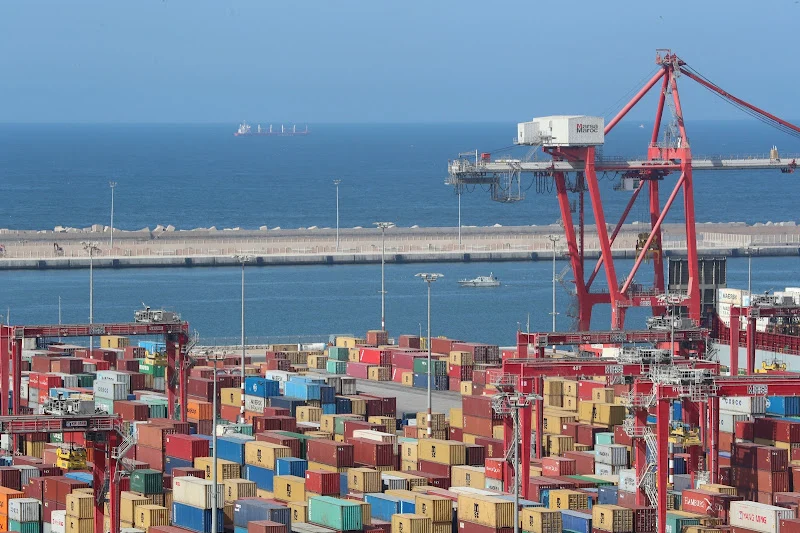
International shipping companies have jolted Moroccan importers with a new round of increases in container freight rates. Customs brokers at the ports of Casablanca and Tanger Med, the agents who handle clearance paperwork for imported goods, passed along the details of notices received from the carriers, which set out specific prices by container size and shipping route along with warnings to brace for these increases to be folded into import costs starting 1 July. (For context, Tanger Med, on the Strait of Gibraltar facing Spain, is the largest container port in Africa and the Mediterranean, while Casablanca is Morocco’s historic commercial port; together they handle the bulk of the country’s seaborne trade.)
Hespress has learned from well-placed sources that Moroccan importers have rushed to contact suppliers abroad, particularly in China, to revisit contracts for shipments scheduled in the coming months, hoping to renegotiate prices in light of the rising cost of sea freight after concluding that their profit margins had been sharply squeezed by these unexpected operating costs.
According to the same sources, one major international carrier kicked off the new increases when it notified customers, Moroccan importers among them, that it was raising the Peak Season Surcharge (PSS) on the shipping route running from Asia toward the Mediterranean and North Africa. The surcharge, the sources said, would apply to dry, refrigerated, and oversized containers, as well as paid empty containers, and would take effect from the date containers are loaded at their port of origin. On that basis, the charge would climb from $900 to $1,400 for a 20-foot container, and from $1,800 to $2,800 for a 40-foot container.
A peak season surcharge is an extra fee carriers add during the busy summer-to-autumn stretch when demand for cargo space outstrips supply. The figures reported here line up with publicly announced moves across the industry: the shipping group CMA CGM, for one, has flagged a peak season surcharge of $1,400 per 20-foot container on the Asia-to-Mediterranean trade, effective 1 July, matching the levels Moroccan importers are being warned about.
The same sources confirmed that large Moroccan importers fear the increases will push up the cost of bringing in goods and raw materials, especially from Asian markets, with knock-on effects on company profit margins and on the final prices of some products in the domestic market. The timing is difficult: carriers are moving to pass on extra charges during a period that typically sees heavy global demand for shipping, sharpened this year as retailers bet on strong summer sales and rush to book space, intensifying competition for room aboard ships and driving prices higher still.
The looming increases are tied to an international backdrop of steadily climbing sea-freight prices. Drewry, the London-based maritime consultancy whose World Container Index is a widely watched industry benchmark, recorded a striking rise in recent weeks, with the index moving from $2,216 per 40-foot-equivalent container at the end of April to $3,549 by mid-June, a jump of more than 60 percent in just six weeks; in the week before mid-June alone it rose 3 percent, a sign of how quickly the increases were accelerating. That climb has continued since: Drewry’s index reached $4,166 per 40-foot container in the week of 25 June 2026, a 22-month high not seen since September 2024. Analysts attribute the surge to an unusually early peak season, tight vessel capacity, continued Red Sea diversions, and higher fuel-related costs linked to Middle East tensions.
Hespress sources also pointed to a further complication for Moroccan importers: a growing likelihood that international carriers will reroute part of their cargo traffic toward ports in other countries to avoid extra financial burdens linked to carbon rules applied on certain shipping lanes. (This refers chiefly to the European Union’s Emissions Trading System, which now charges shipping for its carbon emissions on routes touching EU ports, prompting some lines to redesign their networks.) Such a scenario could force importers, especially the larger ones, to look for alternatives in how they schedule imports and time their bookings to avoid any delays or uncalculated extra costs.