


RABAT — Adil Kemoun
Five years after Morocco became one of the first countries in the Arab world to legalize cannabis for medical and industrial use, the government can point to real accomplishments: a functioning regulatory agency, thousands of licensed farmers, a first shipment of medical cannabis exported to Europe.
It can also count, by its own advocates’ arithmetic, the people the reform has not yet reached. More than nine in ten of the farmers who grow the crop remain outside the legal system.
That gap — between a reform widely praised as courageous and a rural economy still dominated by the illicit trade — has become the center of a debate now unfolding in Morocco, its advisory councils and, increasingly, in conversations with foreign researchers who see in the North African kingdom a test case for how a major producer country unwinds a century of prohibition.
Two men, from very different vantage points, have recently laid out the terms of that debate with unusual candor. One is Chakib El Khayari, a longtime activist and researcher from the Rif, the mountainous northern region where cannabis, known locally as kif, has been cultivated for generations. The other is Paul-Lukas Good, a Zurich lawyer who runs one of Europe’s largest legal cannabis trials and who recently turned his attention to Morocco.
A Cautious Law, and Its Limits
The law Morocco adopted in 2021, known as Law 13-21, did not legalize cannabis so much as carve out a narrow legal channel for it. Cultivation is permitted only for medical, pharmaceutical and industrial purposes, only in designated northern provinces, and only under license from a new state regulator, the National Agency for the Regulation of Cannabis-Related Activities, or ANRAC.
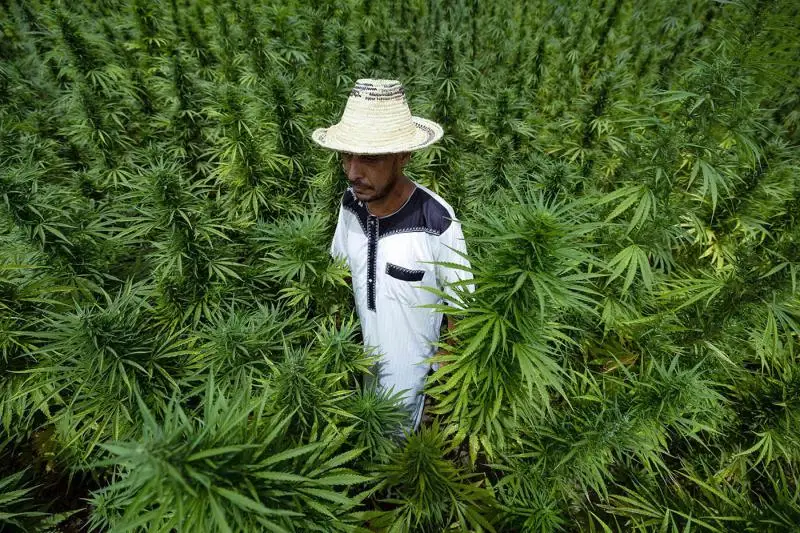
The approach was deliberately incremental. Officials described it at the time as almost experimental, a way to test the system before expanding it. The intended beneficiaries were the farming families of the Rif, whose livelihoods had long depended on a crop that was socially tolerated but legally punished, leaving tens of thousands of growers exposed to prosecution.
By the agency’s own count, the system is growing. ANRAC issued 4,147 new authorizations in 2025, according to figures released by its director general, bringing the total to 5,765 — most of them cultivation licenses covering 5,318 farmers, along with 273 permits for processing, marketing, export and transport.
Mr. El Khayari, who coordinates the National Collective for the Legalization of Cannabis and spent years advocating for the region’s farmers, does not dismiss those numbers. In a lengthy interview published in June by the Moroccan financial weekly Finances News Hebdo, he called the reform an important advance and credited the agency with building the sector’s first real machinery of licensing, contracts and oversight in a region long marked by informality and mistrust of the state.
But he insisted the figures be read against the scale of the phenomenon. By the most conservative estimate, at least 60,000 families in the Rif live directly or indirectly from cannabis. If each of those families includes at least one active grower, the licensed farmers amount to less than 10 percent of the potential total.
The rest, he said, remain where they have always been: dependent on the illegal market. Not, he was careful to argue, because they are traffickers, but because for most of them the illicit economy is still the only buyer available.
The Market the Law Left Out
The reason, in Mr. El Khayari’s telling, is structural. Morocco’s law covers medicine and industry but says nothing about recreational use — which is, as he put it, the principal economic engine of the cannabis trade. As long as the largest share of demand sits entirely outside the law, he argued, the illicit networks retain their customer base, and the legal channel cannot grow fast enough to absorb the mass of farmers.
His conclusion is one that until recently was rarely voiced so plainly in Moroccan public life: the country should open a serious national debate on legalizing recreational cannabis under strict state control.
He was quick to draw boundaries around the idea. What he envisions is not commercial liberalization on the American model but a tightly regulated market built on public health principles: quality control, taxation, traceability, age limits, prevention programs and sanctions for abuse. The point, he said, is not to encourage consumption but to reduce risk — to bring under state supervision a market that already exists, rather than leaving it to criminal networks.
Nor, he argued, would such a debate be a rupture. Morocco’s Economic, Social and Environmental Council and the royal commission that drafted the country’s New Development Model have both treated cannabis as part of a larger question of territorial development and social justice in the north. Refusing the debate, he said, amounts to letting the status quo work for the traffickers alone.
A Pardon, and Identity Cards in the Mountains
If the economics of the reform remain unfinished, its social dimension has moved faster, and here Mr. El Khayari’s assessment turns warmer.
A royal pardon granted to 4,831 people who had been convicted, prosecuted or sought by the police in cannabis cultivation cases was, he said, a major turning point — it lifted some of the fear that had kept farmers from registering with the state, and signaled that the reform was meant to reconcile the region with legality, not merely to create a new industry.
He reserved particular praise for a less visible initiative. Beginning in September 2024, the national police sent mobile units into remote mountain communes of Taounate, Taza and Al Hoceima provinces to issue and renew national identity cards, many of them for small farmers covered by the pardon. In a region where an identity card is the key to public services, digital procedures and ordinary legal existence, he said, the campaign marked a shift in the state’s posture: from an administration that waited for citizens to come to it, to one that went to them; from a relationship built on fear of prosecution to one built on recognition.
Still, he cautioned, a pardon opens a door; it does not guarantee anyone walks through it. Farmers will leave the illicit circuit for good, he said, only if the legal one offers fair prices, regular payments, simple procedures and protection from middlemen who capture most of the value.
The View From Zurich
Mr. Good arrived at the same crossroads from the opposite direction.
A lawyer by training, he is president of the Swiss Cannabis Research foundation, which runs a pilot project with the University of Zurich and the Swiss Federal Institute of Technology studying what happens when adults are allowed to buy cannabis legally for recreational use. Switzerland, in other words, started with the consumer; Morocco started with the farmer.
In interviews with the Moroccan news site Hespress and with Morocco World News, Mr. Good offered a broadly favorable reading of the Moroccan experiment. Prohibition, he said, never made cannabis disappear anywhere; it simply pushed the value of the crop into the shadows. For a producer country, he argued, legalization has a particular logic: the added value is created where the plant grows, and a legal framework allows it to stay there — with the farmers and the state — instead of draining into the informal economy.
He called Morocco’s sequencing sensible: regulate cultivation first, direct it toward medical and industrial uses, and build from there. The pardon of the farmers struck him as legally coherent as well as humane, resolving what he described as the contradiction between an old penal code and a new economic policy.
But asked whether Morocco’s approach could defeat the international smuggling networks, he gave an answer that could have been lifted from Mr. El Khayari’s interview. The design is correct, he said, but not yet sufficient. The legal channel covers only a small fraction of actual production and cannot compete with black-market prices; most farmers remain tied to illegal buyers not out of criminal intent but because no economically viable legal path exists. The ground will be pulled from under the traffickers, he said, only when the legal channel becomes more attractive than the illegal one — and when regulators eventually confront the entire supply chain, consumption included.
If consumption stays unregulated, he said, that link of the value chain stays in the hands of organized crime, no matter how well cultivation is governed.
An Unlikely Partnership
The two countries are already doing more than trading observations. In February 2025, Morocco approved its first export of medical cannabis to Switzerland, through the Swiss firm Medropharm — a small shipment with outsize symbolism, demonstrating that a legal supply chain between a traditional producer country and a European market could clear regulatory scrutiny on both ends.
Mr. Good sees in it the outline of a durable division of labor: Morocco contributing an old agricultural tradition, genetic diversity and a favorable climate; Switzerland contributing pharmaceutical standards, laboratory infrastructure and access to European markets. He is careful to note the limits of his role. The core regulatory principle — monitor, measure, document — is not Swiss property, he said, and the detailed design of Morocco’s system is Morocco’s business.
He believes, though, that the Swiss trials carry lessons worth studying in Rabat. Early results, he said, show revenue drained from the illegal market, new jobs and tax income for the state, and public health gains from moving consumers into a supervised channel: age checks, labeled potency, trained sales staff, less harmful product formats and referral to treatment for those who need it — none of which the black market provides.
The Question That Remains
For all the differences in accent, the two converge on a single unresolved question, one Mr. El Khayari says Morocco must now have the courage to pose in public: whether to leave the recreational market, which exists in fact if not in law, entirely to criminal networks, or to bring it under the control, taxation and health safeguards of the state.
He does not underestimate what else the reform requires. The Rif, he argued, should not be reduced to a cannabis zone at all; it is a mountain region that needs roads, water, schools, clinics and jobs, and its families cannot all live from one crop, legal or not. He has proposed a specific legal framework for mountain territories, and warned against trading an illicit dependency for a legal one.
But the harder question will not wait indefinitely. Legal experiments in Switzerland, Germany and elsewhere in Europe are generating exactly the kind of data Morocco lacked when it wrote its law. Mr. Good’s advice, distilled from years of running one such experiment, is that neither country should answer on instinct: test first, measure carefully, and legislate on the evidence.
Mr. El Khayari’s version is blunter. Closing the debate, he said, benefits no one but the traffickers.