


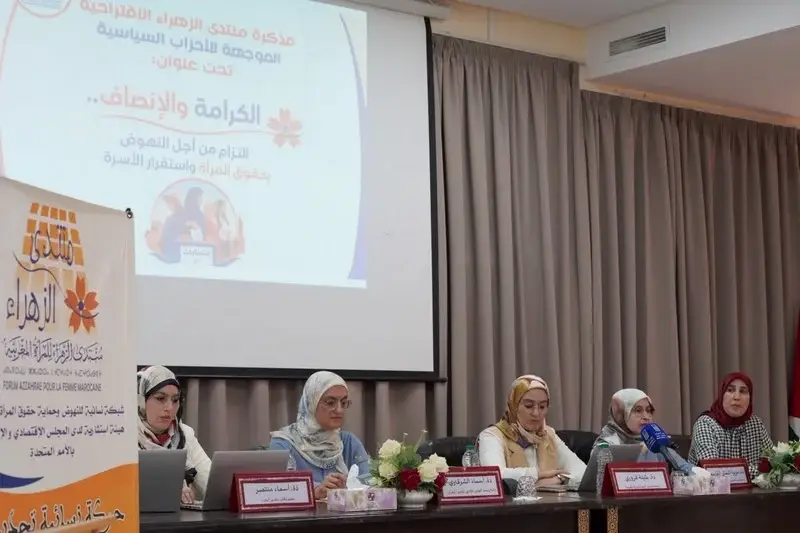
A set of demands drawn up by the Al-Zahra Forum for the Moroccan Woman has put several practical, “implementable” measures to the political parties aimed at improving family stability and supporting women’s participation in development, at a time when Morocco’s political bodies are busy preparing their platforms for the 2026 elections.
Presented at a press conference, the memorandum — titled “Proposal Note Addressed to Political Parties: Dignity and Equity — A Commitment to Advancing Women’s Rights and Family Stability” — set out a number of proposals, among them the creation of a national fund to encourage young people to marry by offering direct, non-repayable grants, backed by family-preparation programs.
The document, reviewed by Hespress, stressed that the aim of the fund is to achieve social and economic stability and to curb negative social phenomena that are costly to individuals and society alike.
To address the burden of the “high financial costs tied to starting a family,” the memorandum proposed interest-free loans for newlyweds, coupled with a mechanism for gradually writing off the loan according to the number of children.
The forum argued that such loans should carry a flexible, easy repayment period of up to four years and be aimed specifically at young people on low or middle incomes to help them meet the costs of marriage. It also called for adopting a model inspired by successful international experiences, whereby 25% of the government loan’s value is written off on the birth of a first child, 50% on the second, and the loan is fully forgiven on the birth of a third.
Beyond this, the memorandum proposed setting aside a quota in state-supported housing programs for newlyweds — those married less than two years — with direct financial support toward the down payment, alongside subsidized home loans at near-zero interest for young families where both spouses are under 35, backed by a government guarantee to cushion against the risk of temporary job loss.
Extending maternity leave
On proposals related to women and work, the forum flagged the problem of the short duration of maternity leave available to pregnant working women and employees, currently set at 14 weeks, warning that many women are forced to stop working during the first year after giving birth.
It proposed extending maternity leave to six months, with the option of renewing it once at half pay and a second time without pay. The forum also called for public-service law to stipulate the provision of nursery spaces, treating them as essential facilities within workplaces as already required under the Labour Code, after finding no such obligation in the basic public-service statute.
The document further called for exempting women from any rise in the retirement age, or making it optional for them, with the possibility of lowering it by five years in certain fields. In return, it demanded a provision allowing a husband to draw on his deceased wife’s pension immediately after her death, rather than deferring it until he reaches the age of 60.
Social protection for women
On strengthening women’s access to social protection, the Al-Zahra Forum called for guaranteeing free or near-free preventive and curative services linked to reproductive health, pregnancy and motherhood, as well as the early detection of cancers and chronic illnesses.
It also demanded the creation of a dedicated fund to support women working in the informal sector, financed through a partnership between the state and the private sector, to help cover maternity-related health expenses. On the same theme, the memorandum called for regular screening for the early detection of psychological disorders during pregnancy and after childbirth, along with raising the reimbursement rate for psychological consultations and treatments tied to that period.
Caring for “accompanying” families
The memorandum also addressed the burden shouldered by families of children with disabilities — mothers in particular — who bear the greatest share of care, treatment and rehabilitation costs, deepening their economic and social vulnerability. Accordingly, it proposed direct, regular financial support for these families, calibrated to the degree and type of disability and the family’s level of vulnerability.
The document stressed recognizing the status of “accompanying mother” or “family assistant,” with guaranteed social coverage, psychological support, training and flexibility at work.