
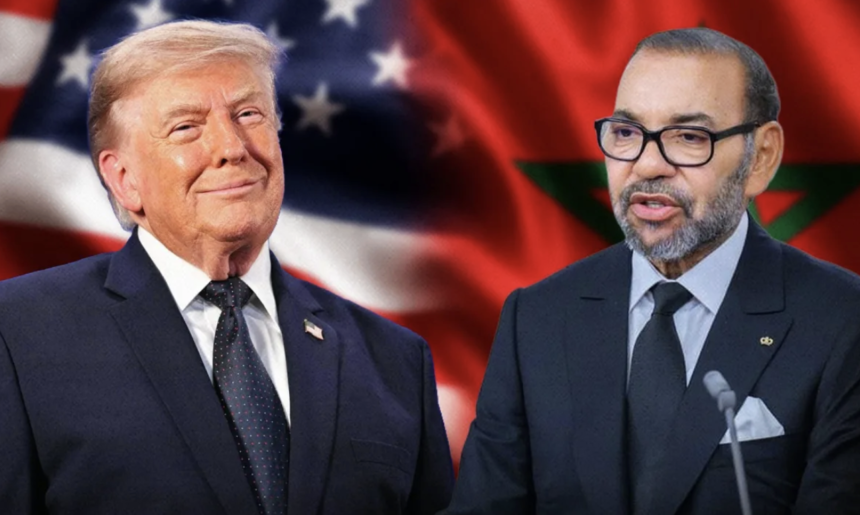
The 1,055-kilometer highway running down Morocco’s Atlantic coast now carries an unexpected name: Donald J. Trump. On Sunday, the US president took to his Truth Social platform to thank King Mohammed VI for the gesture, calling it “a great honor,” according to Moroccan outlet Hespress.
“Thank you to His Majesty King Mohammed VI, King of Morocco, for this great honor. It is a great honor indeed! I look forward to traveling the full length of this magnificent expressway one day, and I hope it will be soon,” Trump wrote.
The message was accompanied by a promotional video presenting the Tiznit–Dakhla Expressway as a strategic project linking the north of the kingdom to its far south along 1,055 kilometers of newly upgraded road — and framing it as a cornerstone of the royal initiative to open the Atlantic seaboard to the landlocked Sahel countries.
A symbolic road
The video does not stop at infrastructure. It reaches back to 1777, when Morocco became the first country to recognize the newly independent United States, and to the Treaty of Peace and Friendship that followed — the oldest continuous diplomatic relationship in American history. In the film’s telling, the highway becomes a symbol of the friendship between Rabat and Washington, a bridge for development, peace, and prosperity, and a strategic gateway connecting Morocco to its African hinterland and to international markets.
An expressway with a history — and a political charge
The Tiznit–Dakhla project is not new. Launched by King Mohammed VI in 2015 to mark the 40th anniversary of the Green March, it was designed as the flagship transport artery of a broader development model for Morocco’s southern provinces, at an eventual cost of around 10 billion dirhams. Successive sections have been opened over the past two years, dramatically cutting travel times between the north and the south of the country.
What is new is the name — and the politics attached to it. The expressway runs deep into Western Sahara, the disputed territory that Morocco administers and claims as sovereign, and where the Polisario Front continues to press for independence. During his first term, and again in 2025, Trump backed Morocco’s position on the territory, a stance that has become one of the anchors of the current warming between the two capitals.
The gesture also follows a series of recent diplomatic exchanges. Earlier this month, on the occasion of US Independence Day, King Mohammed VI sent a congratulatory message to Trump reaffirming Morocco’s commitment to deepening its longstanding strategic partnership with Washington.
A quiet Rabat
One detail bears watching. In the hours after Trump’s post, Moroccan authorities had not issued their own official announcement of the renaming, and neither the White House nor the Moroccan embassy in Washington had publicly commented, according to international outlets that picked up the story. Whether the “Donald J. Trump Expressway” becomes the formal designation of Morocco’s longest highway — or remains, for now, a name announced from a social media account in Palm Beach — is a question Rabat has yet to answer on the record.
What is clear is the political message the gesture sends: at a moment when Morocco is consolidating international recognition of its position in the Sahara and courting American investment in Dakhla’s new billion-dollar deepwater port, putting Trump’s name on the road that leads there is, at the very least, a carefully chosen piece of diplomatic signaling.