
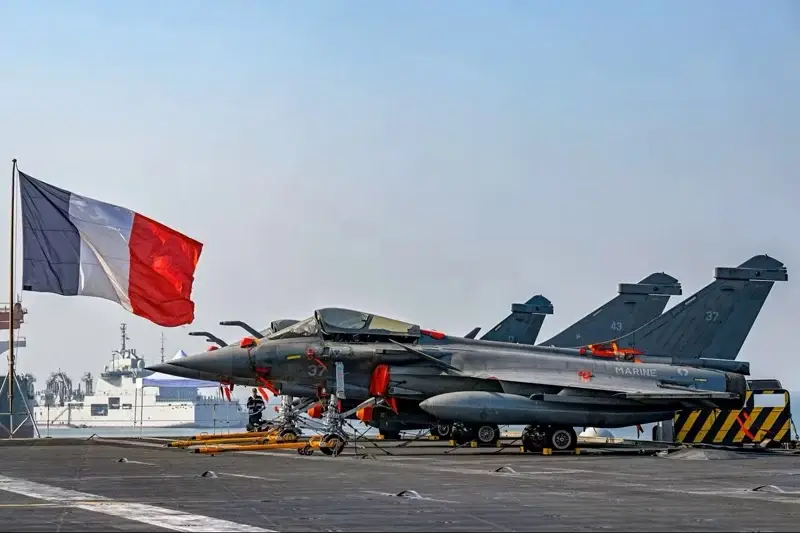
A long-dormant deal for Morocco to acquire French Rafale fighter jets — first floated in 2007 before being shelved — may be heading back to the negotiating table, according to a recent report from the defense-focused platform Defensa. The outlet frames the possibility as more than a fresh arms sale: it casts it as a test of whether Paris can overcome the financing, political and industrial missteps that sank the deal the first time around.
According to the report, 2026 is shaping up to be a pivotal year in Morocco–France defense relations. It points to a recent high-level visit to Paris by a senior Moroccan military delegation led by Inspector General of the Royal Armed Forces and commander of the southern zone, General Mohamed Berrid, together with Brigadier General Fouad Moumen, head of the bureau responsible for equipment and military contracts, and Abdellatif Loudiyi, the minister-delegate for national defense administration. Defensa describes the trip as one of the most significant Moroccan military visits to France in years — not only for the seniority of those involved, but for its political context: it coincides with preparations for an anticipated state visit by King Mohammed VI to Paris and the drafting of a comprehensive strategic treaty meant to frame relations between the two countries for decades.
Echoes of a 2007 failure
The renewed prospect, the platform notes, revives memories of how the original deal collapsed. At the time, Paris was confident the Moroccan market favored French industry, given the Royal Air Force’s long history with Dassault systems — particularly the Mirage family. What followed, however, was not a technical defeat for the aircraft but a botched handling of the file: France’s arms-procurement directorate and the Rafale industrial consortium pursued uncoordinated negotiating tracks with the Moroccan side, and France failed to put forward a coherent financing offer with clear credit guarantees.
Paris had also gambled, the report says, that Saudi Arabia or the United Arab Emirates might serve as indirect financiers of the Moroccan purchase — an assumption that proved wrong and left a vacuum that the United States quickly exploited with its own offer of F-16s, in a deal worth roughly €2 billion. Defensa characterizes that outcome as a political and industrial shock for the Élysée, precisely because it happened in a market long considered safe for France.
Since then, the platform argues, France has changed how it markets the Rafale: the file is now handled at the highest political levels, with the jet bundled together with financing packages, political guarantees, technology transfer, and close coordination between the state and industry. On that reading, any new discussion of the “Rafale F4.3” variant with Morocco in 2026 would represent not just a potential sale but a historical correction of an earlier negotiating error — with France this time better prepared to approach Rabat with an integrated offer spanning industrial partnership, financing and long-term support.
Why Morocco may want a second platform
On the military rationale, the report recalls that the Royal Moroccan Air Force has historically relied on a two-fleet logic, at earlier stages pairing the Mirage F1 with the F-5 to provide a mix of mission capabilities and an alternative source of training, weapons and maintenance. But after years operating the F-16 Block 52 — and with the newer Block 72 version due to arrive — the backbone of the air force has become heavily dependent on American systems.
That reliance, Defensa argues, has given Rabat advanced capabilities but made a second combat platform more pressing, both to avoid total dependence on a single supplier and to preserve room to maneuver should supply chains grow complicated or allies’ political priorities shift — especially with the imminent retirement of the in-service Mirage F1, which could otherwise leave the entire Moroccan fleet under exclusively American technical sovereignty.
The Rafale F4.3, the report explains, is a “generation 4.5” twin-engine aircraft designed from the outset as a multi-role platform capable of air defense, deep strikes, naval attack, reconnaissance and precision close air support. Morocco, it suggests, is not merely trying to fill a numerical gap left by the retiring Mirage F1 but to rebuild a qualitative balance within its fleet — avoiding full dependence on the American F-16 while also declining to settle for a used platform, however upgraded, in the face of an Algerian fleet that continues to evolve with advanced Russian jets and could open up to Chinese options in the future.
A complex, costly proposition
Were Morocco to move toward the Rafale, the platform expects it would tie the deal to a broader package potentially including electronic reconnaissance solutions or intelligence cooperation with France and other partners. But it cautions that the deal would be neither easy nor cheap: the cost of any aircraft is measured not by the unit price alone but by the full bundle of weaponry, training, simulators, spare parts, infrastructure and technical support.
Timing and production constraints also matter. Rafale production lines are currently busy meeting France’s own domestic orders and a backlog of export demand, so Morocco joining the customer list now would not necessarily mean immediate delivery. The theoretically faster route, the report notes, could be drawing aircraft from French Air Force stocks or from production slots originally earmarked for France — as has happened in earlier European cases — though that would require a decisive French political decision and internal compensation for the French military.
Defensa concludes that such a deal, if realized, would amount to more than a rebalancing of Moroccan airpower: Morocco would gain a twin-engine platform, long-range weaponry, a strong electronic-warfare suite, and an arms source relatively independent of the American system. France, in turn, would preserve its strategic foothold in North Africa and secure a prominent defense partner beyond Europe’s borders.