

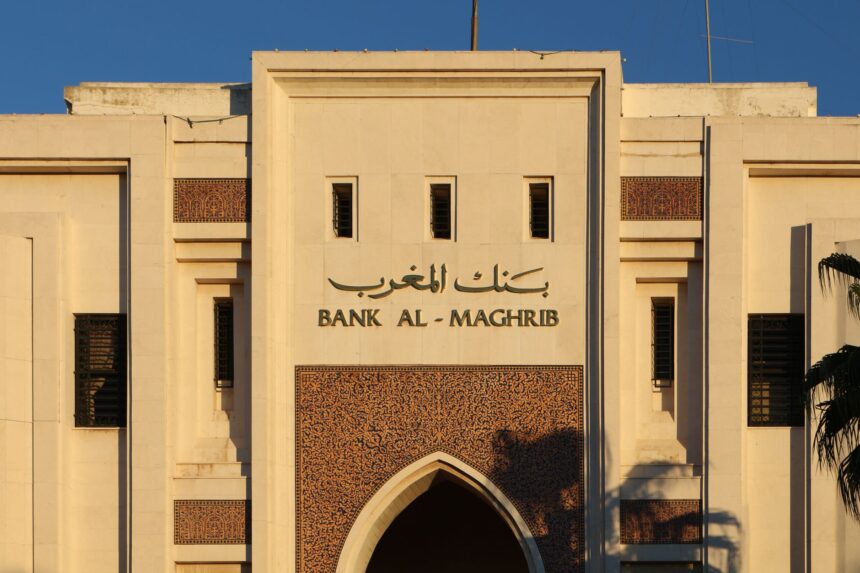
The seven banks listed on the Casablanca Stock Exchange increased their combined net profit, group share, by 6.7% to 13.35 billion dirhams in the first half of 2026. Their net banking income rose only 1.34% to about 49.7 billion dirhams. The gap shows that profit growth came mainly from a sharp fall in the cost of risk, which dropped about 35%, rather than from a surge in business activity. This raises questions about whether the sector can keep up the same pace of profit growth in the second half.
The main boost to profits came from lower provisions for credit risk. These fell from 6.9 billion dirhams in the first half of 2025 to 4.5 billion dirhams in the same period of 2026, a drop of about 35% that saved the banks around 2.4 billion dirhams in costs. That is almost three times the increase in combined net profit, which was only about 840 million dirhams, showing how much the improvement in risk weighed in the profit equation.
Core business remains solid
Core banking activity held up well. Combined outstanding loans exceeded 1,300 billion dirhams, and deposits approached 1,500 billion dirhams, putting the loan-to-deposit ratio at about 87%.
The banks benefited from an 8.1% rise in their interest margin and a 6.6% increase in fee and commission income. However, a large part of these gains was absorbed by a 22.7% drop in income from market activities and by higher operating costs at several institutions.
Three banks dominate the sector
Profits remain concentrated among the three largest banks, Attijariwafa Bank, Banque Centrale Populaire (BCP) and Bank of Africa, which together earned about 11.64 billion dirhams, or nearly 87% of the total profits of listed banks.
Mid-sized banks grew faster, especially BMCI, whose profit jumped 58.2%, and Crédit du Maroc, which posted growth of 19.4%.
Cost of risk reshapes profitability
A closer look at the banks’ accounts shows that the strongest driver of first-half results was not higher revenue but lower amounts set aside to cover credit risk.
Operating income reached about 24.3 billion dirhams, up 7.7%. But when the cost of risk is added back, the estimated income before this cost comes to about 28.8 billion dirhams, compared with nearly 29.5 billion dirhams a year earlier. This suggests that the sector’s underlying operating capacity did not improve as much as its final profits suggest.
“The large gap between net banking income growth, limited to 1.34%, and the 6.7% increase in profits means the results should be read in terms of asset quality rather than business expansion,” said Othmane Aboulfadl, a financial data analyst at an investment bank in Casablanca.
Speaking to Hespress, Aboulfadl explained that lower provisions freed up a significant share of income that had previously been used to cover loan risks, allowing a larger portion of operating income to turn into net profit.
He said the roughly 35% drop in the cost of risk is a positive sign for loan portfolios, but it makes future comparisons harder. “Continued profit growth at the current pace will require either further improvement in risk or faster growth in net banking income to offset the fading effect of provisions, because this lever alone cannot support profits indefinitely,” he said.
BCP: higher profit despite lower revenue
Banque Centrale Populaire illustrates this clearly. Its net profit, group share, rose 10.4% to 3.22 billion dirhams, even though its net banking income fell 3.2% and its gross operating income dropped 9.7%. Over the same period, the bank’s cost of risk fell from 2.70 billion dirhams to 1.08 billion dirhams, a difference of more than 1.6 billion dirhams.
Attijariwafa Bank: growth driven by volume
Attijariwafa Bank, which alone accounts for about 45% of the sector’s profits, followed a different model. Its profit rose 1.1% to 5.94 billion dirhams, while its net banking income increased 4% to 18.4 billion dirhams. Its outstanding loans grew 11.2% to 464.3 billion dirhams, and its customer savings rose 13.8% to 553.8 billion dirhams, reflecting a greater reliance on commercial volume growth.
Market activities weigh on revenue
Market activities provided less support, with combined income falling 22.7% after a strong first half of 2025 created a high base for comparison. This income fell about 37% at Bank of Africa and 28% at BCP, which limited the positive effect of higher interest margins and commissions on total net banking income.
Second half will test the sustainability of profits
After the first six months, the banks have already achieved 56.3% of the annual profit analysts expect for the sector, estimated at about 23.69 billion dirhams. To reach these forecasts, they need to earn about 10.34 billion dirhams between July and December, or about 23% less than in the first half.
Progress toward annual forecasts varies widely between banks:
- BMCI: 72.2% of expected annual profit
- Bank of Africa: 64.4%
- BCP: 62.8%
- Crédit du Maroc: 56.1%
- Attijariwafa Bank: 51.2%
- CIH Bank: 50.5%
- CFG Bank: 46%
Nabil El Khabbat, a financial adviser and independent stock market analyst, said these percentages should not automatically be read as a sign that banks will beat their annual forecasts, since business seasonality differs between banks and the cost of risk and market income may change in the second half.
“The key question for investors will not just be how much profit was made, but the quality of its sources and how sustainable they are,” he told Hespress.
He said the market will watch closely whether banks can accelerate net banking income growth if the decline in provisions loses momentum, adding that continued growth in loans, interest margins and commissions will be decisive.
“The most solid results in the medium term are those that combine commercial expansion, a controlled cost-to-income ratio and a cost of risk that stays low and stable, rather than relying mainly on an accounting item that fluctuates from one half-year to the next,” he said.
Digital investment raises costs
Cost control is becoming more important as banks continue to invest in digitalization and IT modernization. Operating costs at Bank of Africa rose about 8%, while Attijariwafa Bank’s cost-to-income ratio rose from 35.3% to 36.8%. These figures reflect the direct cost of technological transformation and expanding operations, although these investments may later bring productivity gains.
Mid-sized banks post strong growth
Mid-sized banks recorded strong growth rates. BMCI’s profit rose from 222.8 million dirhams to 352.5 million dirhams, up 58.2%. Crédit du Maroc earned 532 million dirhams, up 19.4%, and CFG Bank about 200 million dirhams, up 10.5%. Even so, the combined profits of the four banks outside the top three did not exceed 1.7 billion dirhams, or about 13% of sector profits.
A more complex picture than profits suggest
With strong loan growth, weak market income and lower risk costs, Morocco’s listed banks enter the second half facing a more complex situation than rising profits suggest. If loan portfolio quality keeps improving and operating revenue accelerates, the sector can consolidate its first-half gains. But if provisions rise again without a matching recovery in net banking income, the gap between business growth and profit growth will become more visible in the annual accounts.