


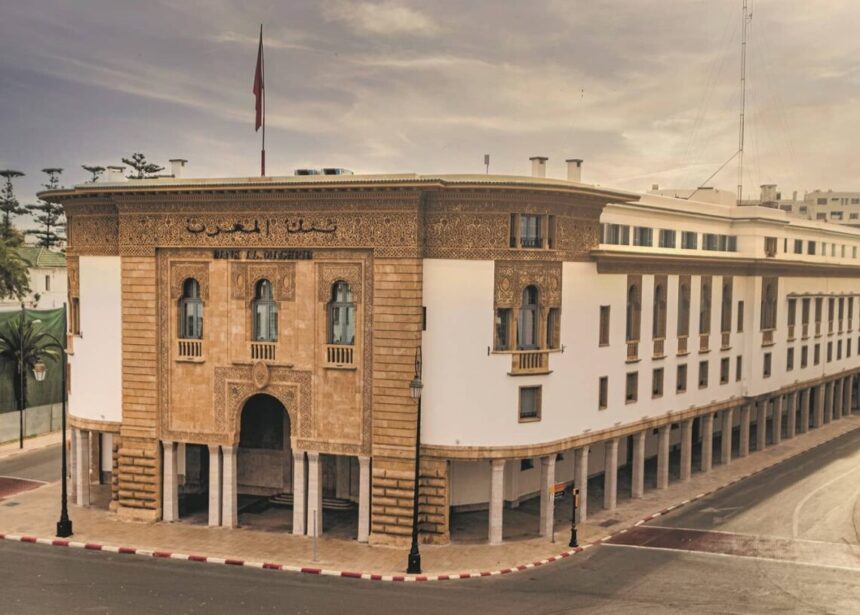
Bank Al-Maghrib (BAM), Morocco’s central bank, is likely to keep its benchmark interest rate frozen at 2.25% for the remainder of 2026, choosing caution as inflationary pressures build across the global economy, according to a new outlook from Attijari Global Research (AGR), the research arm of one of the country’s largest banking groups.
AGR expects an extended monetary “pause” — a period in which the central bank neither raises nor lowers rates — and argues that BAM will hold its current stance until it has a clearer picture of how persistent energy price shocks are feeding into imported inflation. Because Morocco imports much of its energy, swings in global oil and gas prices tend to pass through to domestic prices, making the cost of imported goods a key variable for policymakers. In its report, AGR said it anticipates the pause lasting through the end of 2026 while the scale of the energy shock and its effect on imported inflation are assessed.
The research house sees a possible turning point further out. If international Brent crude prices stabilize gradually and Morocco’s medium-term trend of slowing inflation continues, AGR believes the conditions could be in place for the central bank to resume cutting rates from the second half of 2027.
For now, AGR reads BAM’s decision in June to leave its rate unchanged as a deliberately prudent move at a moment when global uncertainty continues to cloud the inflation outlook. The firm cautions that a combination of prolonged volatility in energy markets, accelerating inflation abroad, and the tighter monetary policies of major central banks could push Morocco’s inflation rate above 1.5% — and potentially toward 2% year-on-year — by 2027. For context, BAM has projected inflation of roughly 1.5% in 2026 and 2.1% in 2027, figures that remain modest by international standards but are sensitive to external shocks.
The June decision to hold at 2.25% was widely expected by financial markets and marked the fifth consecutive meeting at which the bank left borrowing costs untouched. It came at the second monetary policy meeting of 2026; BAM’s governing council meets quarterly to set rates.
The current standstill follows an easing cycle that ran from June 2024 to March 2025, during which BAM cut its benchmark rate by a cumulative 75 basis points — three successive reductions of 25 basis points each. (A basis point is one-hundredth of a percentage point, so 75 basis points equals 0.75%.) Those cuts were designed to support economic activity while keeping inflation inside the bank’s target range.
The broader message from AGR is that, unless external inflationary pressures ease meaningfully, BAM is likely to keep prioritizing price stability over stimulus in the months ahead — leaving any further rate cuts off the table until 2027 at the earliest.