



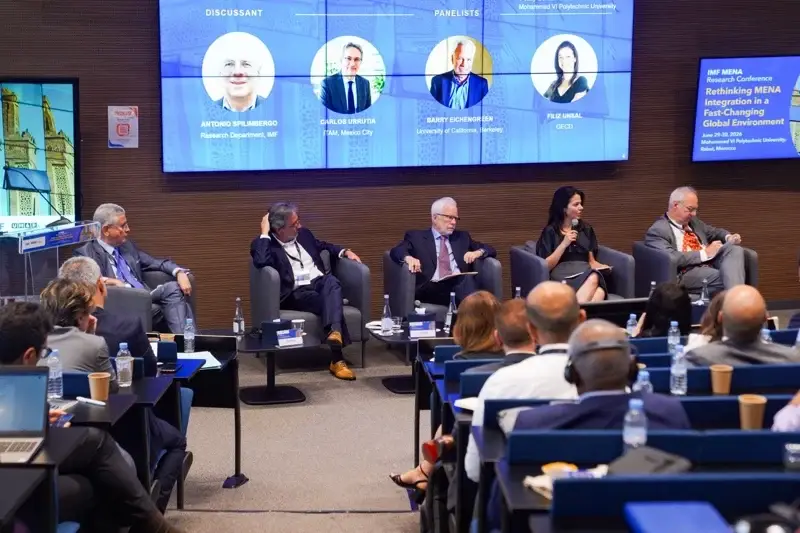
Leading researchers gathered in Rabat on Monday for the second annual research conference of the International Monetary Fund’s Middle East and North Africa division, turning their attention to the growing strategic weight of artificial intelligence in shaping the future of the world’s economies, with particular focus on the Global South and the MENA region as it continues to grapple with uncertainty and geo-economic fragmentation.
Farid Belhaj, a senior fellow at the Policy Center for the New South at Mohammed VI Polytechnic University and former World Bank vice president for the Middle East and North Africa, argued that digital transformation is no longer a secondary option but has become a central force reshaping the economic and social foundations of the region. He called for a clear-eyed reading of both the opportunities and the risks that accompany the technological surge, stressing the value of evidence-based research in equipping policymakers to meet the challenges of the digital age.
Technology reshapes the world of work
The opening presentation explored the links between technological change, jobs and labor markets, drawing on research conducted and presented by Gustavo Leyva of the Center for Latin American Monetary Studies and Carlos Urrutia of the Autonomous Technological Institute of Mexico. The two examined the dynamic relationship between accelerating technological change and the structure of labor markets.
They explained that the adoption of artificial intelligence and automation is driving fundamental shifts in the nature of work, with demand for routine tasks declining sharply while occupations requiring advanced analytical and technological skills rise. The researchers warned that wage gaps and inequality within labor markets could widen unless the transition is matched by sustained education and training policies to reskill the workforce. The presentation also underscored the particular situation of developing and emerging economies, noting that a labor market’s flexibility and capacity to absorb technological shocks depend directly on its regulatory frameworks and the scale of investment in human capital.
AI in a fragmented world
A team of IMF experts — George Kuy, Asma El Jnaini, Yevgenia Korniyenko, Iliad Shojaei, Li Zeng and Frank Zhang — addressed the theme of artificial intelligence in a fragmented world during the same session, examining how AI is spreading against a backdrop of global division and geopolitical splintering.
According to the researchers, international competition to lead the technology and AI sector could give rise to closed technological “blocs,” obstructing the free flow of knowledge and data across borders and depriving developing nations of the full benefits of these tools. They cautioned that such fragmentation threatens to deepen the digital divide between advanced and developing economies, and concluded that flexible international governance frameworks and shared standards for AI are needed to keep the technology a driver of inclusive global growth rather than a fresh source of economic and political division.
Challenges facing the MENA region
A researcher from the Organisation for Economic Co-operation and Development (OECD) presented an analysis of AI’s impact on productivity, with a focus on the MENA region. OECD representatives told the session that artificial intelligence offers enormous potential to raise production efficiency, improve resource allocation and create new services and products that help accelerate economic growth beyond traditional sectors.
They nonetheless pointed to structural obstacles facing the region, including weak digital infrastructure in some countries, a shortage of specialized skills, and the slow uptake of these technologies among small and medium-sized enterprises. The participants recommended structural reforms spanning a stronger regulatory environment, incentives for innovation, and public-private partnerships to clear the hurdles and achieve a leap in productivity.
The session closed with a wide-ranging response from Antonio Spilimbergo, deputy director of the IMF’s research department, who offered a critical synthesis of the papers presented. He argued that the core challenge lies not in the technology itself but in how quickly and how far macroeconomic policy can adapt to it. Striking a balance between encouraging innovation and curbing the risks that accompany AI — such as technological unemployment and cyber threats — will demand unprecedented agility from central banks and finance ministries, he said.
The conference, held amid a regional and international landscape marked by conflict, economic uncertainty and rapid structural change, is organized in partnership with Mohammed VI Polytechnic University. The event set out to examine several core themes: the fallout from global shifts and the effect of evolving trade patterns and geo-economic fragmentation on the region’s economies; the digital revolution and the prospects for technological transformation led by AI; and the frameworks of economic policy, exploring the vital role of monetary, fiscal and labor-market policy in preserving macroeconomic stability and driving resilient, sustainable and inclusive growth.