
By Rachid Raha — President of the World Amazigh Congress and the “David Montgomery Hart” Foundation for Amazigh Studies
The football match played on Tuesday morning between Morocco and the Netherlands, the author writes, prompted him to revisit what he considers a self-evident question: are Moroccans really Arabs?
It is a question he says he previously put to Elena Sánchez Caballero, then interim president of Spain’s public broadcaster RTVE, in a complaint over what he describes as RTVE news bulletins wounding the feelings of Moroccan and African citizens by labeling Morocco’s national football team as “Arab” during the 2022 Qatar World Cup, when Morocco had reached the quarter-finals. In his message, he maintained that the players of Spain’s southern neighbor represent all Moroccans and North Africans, who are “Imazighen,” not Arabs from the Asian continent. He allowed that describing the team as “Moro” would pose no problem, since the term — derived from “Maurus,” once used for the ancient inhabitants of Mauretania Tingitana, the Roman-era name for the region — is, in his view, more fitting.
He recounts receiving an unsatisfactory reply from RTVE’s audience-ombudsman team, which insisted on describing Morocco and its people as “Arab,” prompting him to write again, asserting that the Kingdom of Morocco has never been an Arab country and, like the rest of North Africa, never will be.
To make his case, the author points to the Club World Cup final between Spain’s Real Madrid and Saudi Arabia’s Al-Hilal, held in Rabat in February 2023. By the ombudsman’s logic, he argues, Moroccan and wider North African crowds should have backed the Saudis as fellow “Arab” and “Muslim” peoples — yet, he says, they enthusiastically supported the “Spanish” and “Christian” side instead. He sees a similar dynamic in the Morocco–Netherlands match, contending that Mexicans, as Catholics, might have been expected to back the Christian Dutch, while Algerians, as Arab and Muslim “brothers,” might have supported the Moroccan players rather than the Dutch.
He invokes the scholar Mohamed Chafik, quoting from his study on the Berbers and their contribution to Mediterranean cultures: “Let our Arab brothers understand that non-Arabs, too, have the right to take pride in their identity. The Berbers (Imazighen) simply want to be Berbers, just as the Chinese are Chinese, the Japanese are Japanese, and the Arabs are Arabs.” Twitter
The author further recalls that when Morocco bid to host the 2026 World Cup, Arab states including Saudi Arabia, the United Arab Emirates, Kuwait, Iraq, Jordan and Lebanon opted, in his telling, to vote for the American bid rather than for a North African neighbor.
Turning to the 2030 World Cup, which Morocco will co-host with Spain and Portugal, he says Amazigh advocates continue to press senior football officials in the three countries — especially Fouzi Lekjaa, president of the Royal Moroccan Football Federation — over what he calls persistent discrimination against the Amazigh language and culture. He notes that the FIFA 2030 presentation held in Rabat in October 2023 included no reference to that language and culture, which he considers an integral part of Moroccan identity, and warns against allowing such exclusion to become a “falsification and amputation of shared memory.”
He argues at length that ancient Imazighen were makers of Mediterranean civilizations and contributors to Andalusian civilization, citing genetic-anthropology research by Spanish immunologist Professor Antonio Arnaiz-Villena of the Complutense University of Madrid, which, he says, holds that “Iberians” and “Amazigh” descend from the same North African origins. He recalls the role of Moroccan Amazigh — known as “the Moors” to their Iberian neighbors — in building the Islamic civilization of al-Andalus over eight centuries, from Tariq ibn Ziyad’s crossing at Gibraltar in 711 to the expulsion of the last Moriscos in 1609.
The author also revisits his February 17 appeal, on the 37th anniversary of the founding of the “Arab Maghreb Union,” in which he called on the foreign ministers of Morocco, Algeria, Mauritania, Tunisia and Libya to dissolve the union, which he argues failed because it was built on denying North Africa’s ancient history and authentic Amazigh African identity and on what he calls a reductive and unsuitable label. He cites the recently held 2025 Africa Cup of Nations as evidence of an absence of solidarity among North African crowds.
On the union’s failure, he quotes King Mohammed VI’s address to the 28th African Union summit in Addis Ababa on January 31, 2017, in which the King lamented that the flame of the Arab Maghreb Union had died out and that it had become the least integrated region on the African continent, if not in the world.
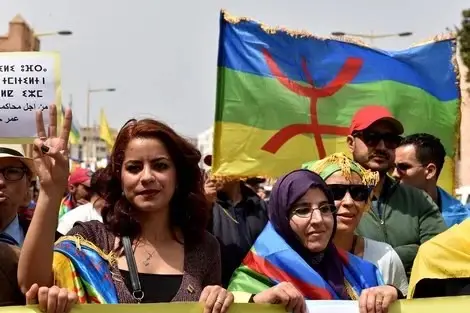
In closing, the author appeals to journalists, intellectuals and academics in the three countries bordering the Strait of Gibraltar to adopt what he calls realistic terminology, away from ideological leanings and the promotion of a receding “Arab nationalism.” He urges them to avoid descriptions such as “the Arab team,” “Arab football,” “the Arab Maghreb,” “the Arab nation” and “the Arab Spring,” arguing that such terms wound the identity and dignity of millions in Morocco and Tamazgha, as well as Europeans of Amazigh origin who, he notes, wave Moroccan and Amazigh flags across EU cities whenever the Atlas Lions win. The success of these young Moroccan Amazigh players, together with the recent opening of an Amazigh museum within Granada’s Alhambra complex, he writes, is reason to deepen research and cultural activity around an Amazigh heritage that he says united these three countries over thousands of years yet remains among the most neglected subjects in their universities.