

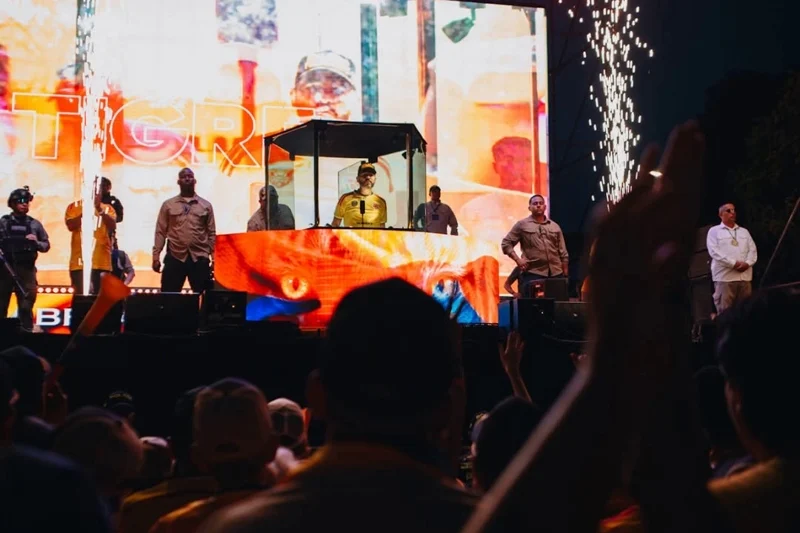
Right-wing candidate Abelardo de la Espriella has won Colombia’s presidential election, defeating leftist rival Iván Cepeda in a result that ends the era of outgoing President Gustavo Petro and opens the door to a shift in the foreign policy of one of Washington’s closest allies in South America.
De la Espriella took the 21 June runoff with 49.66 percent of the vote against 48.70 percent for Cepeda, who conceded on 24 June. Petro, who alleged fraud and foreign interference, has not acknowledged the outcome. With roughly 12.9 million ballots, De la Espriella became the most-voted presidential candidate in Colombian history. He is due to take office on 7 August.
The victory fits a wider rise of the right across Latin America and a growing push to reorder political, security, and economic priorities away from the ideological approaches that defined several of the region’s left-wing governments. A self-described conservative nicknamed “El Tigre,” the 47-year-old lawyer and businessman holds dual Colombian-US citizenship and has promised a hardline approach to organized crime, closer security ties with Washington, lower taxes, expanded oil exploration, and economic liberalization. Endorsed by US President Donald Trump, he has openly admired figures such as El Salvador’s Nayib Bukele and Argentina’s Javier Milei, fueling expectations that Colombia will draw nearer to Washington’s security and political agenda.
That expected realignment is being watched closely in Rabat, where attention centers on a single file: the Western Sahara dispute. Petro’s government revived Colombia’s relations with the Polisario Front in 2022 after more than two decades of dormancy, and Moroccan officials and analysts see in a conservative, US-aligned president an opening to revisit a string of regional positions.
The dispute itself helps explain the stakes. Western Sahara is a former Spanish colony whose status has been contested since 1975. Morocco controls most of the territory and considers it part of the kingdom, proposing autonomy under Moroccan sovereignty. The Polisario Front, which proclaimed the Sahrawi Arab Democratic Republic and is backed by Algeria, seeks independence. The Sahrawi republic is recognized by a number of states and is a member of the African Union, while other countries, including the United States since 2020, have endorsed Morocco’s position or its autonomy plan. The matter remains the subject of a long-running UN process, and Latin American governments have swung between the two sides largely along left-right lines, which is why a change in Bogotá resonates in Rabat.
Political analyst Dadi Bibout argued that the result carries implications well beyond Colombia’s borders and could trigger a broad review of Colombian foreign policy, including a possible reconsideration of recognition of the Polisario Front and a return to the closer ties that long marked relations between the two countries. He cast the rise of the Colombian right as a threat to one of the Polisario’s traditional bases of support in Latin America, suggesting the new authorities could review or even withdraw recognition of the Sahrawi republic in step with the conservative current backing the president-elect. Such a shift, he added, could also lift bilateral trade, helped by De la Espriella’s market-friendly leanings.
Ramdane Messaoud El Arbi, a member of the Royal Advisory Council for Saharan Affairs, a Moroccan state body that advocates for the kingdom’s position on the territory, made a similar case. He linked the significance of the result to the president-elect’s alignment with the international conservative current and his overlap with the Trump administration, which supports Morocco’s sovereignty claim and its autonomy initiative. Petro’s outreach to the Polisario, he argued, was ideologically driven and rooted more in Latin American left politics than in Colombian state interests, and a withdrawal of recognition of the Sahrawi republic remained possible amid the country’s political shift. He framed any such move as consistent with what he described as growing international backing for Moroccan territorial unity.
These remain forecasts rather than Colombian policy. De la Espriella’s incoming government has announced no position on Western Sahara, and Bogotá’s eventual course remains to be seen.
The election did not pass without friction. Cepeda urged supporters to stay calm and await the final count after limited protests and clashes followed the preliminary results in major cities, including Bogotá, warning against deepening polarization in a country still living with sharp left-right divisions. He accepted the outcome once a recount confirmed it.