

By Driss Lagrini
Irregular migration is usually born at the seam between two worlds moving at different developmental speeds. On one side sit the push factors: poverty, unemployment, marginalization, despair, lost trust in the future, and the weakness of the political and social channels that are supposed to shape young lives. On the other sit the pull factors: job opportunities, respect for rights and freedoms, media narratives, and the images young people carry in their heads of the countries they dream of reaching.
The Mediterranean is one of the world’s most exposed spaces to this dynamic. Human-smuggling networks have multiplied there, and mounting security, political, and social crises in a number of African and Arab countries keep pushing individuals to set out in search of safer ground.
But those journeys frequently turn into human tragedies — through the conditions of the crossing itself (robbery, thirst, hunger, violence, rape) or through drowning at sea aboard unfit vessels that lack the most basic safety standards. It is why so many international organizations have taken to sounding the alarm, warning that the Mediterranean basin has become a “mass grave” for migrants.
The rumor that emptied streets
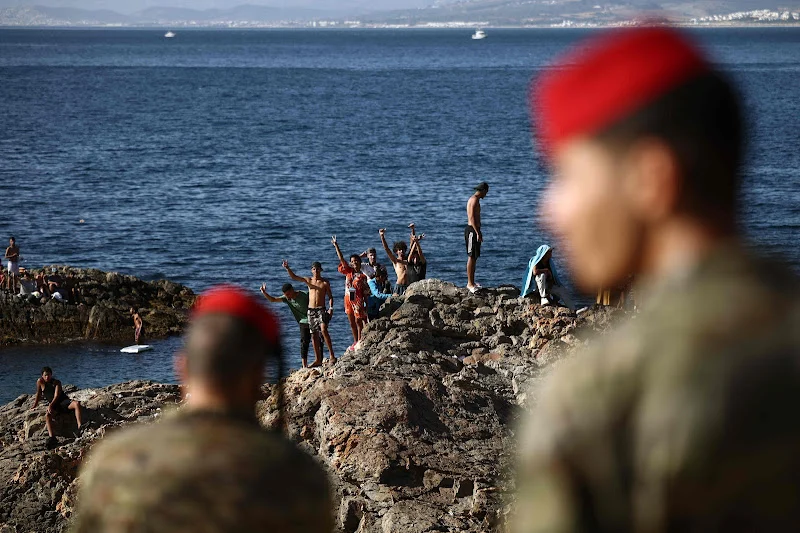
A few days ago, news began circulating on social networks that a Spanish judicial ruling had banned the “immediate return” of migrants arriving at the border by sea. That reading — accurate or not — was enough to galvanize thousands of young Moroccans into attempting the crossing to Ceuta.
In record time, more than 60,000 Moroccan migrants — women, men, children, young people, and older adults — reached the city, in a brutal journey that left a heavy toll of victims.
The crossing has fed extremist and inciting rhetoric from far-right parties and leaders across several European countries. Some spoke of an “Islamic invasion.” Others called for tighter border measures and the immediate expulsion of all irregular migrants to their countries of origin. Racist speech against migrants swept across social platforms, while some voices demanded the suspension of the Schengen agreement with Spain.
Uncomfortable questions Morocco cannot dodge
Set aside, for a moment, the different possible framings of what happened — whether this was a spontaneous popular movement in search of a better life, a deliberate Spanish laxity intended to let the migrants suffer hunger, thirst, and humiliation on the other side so that they would return “voluntarily” and never try again, or a Moroccan message that Rabat rejects the role of Europe’s — and particularly Spain’s — traffic policeman against irregular migration. Whichever interpretation you choose, the shocking images of crowds of all ages that spread like wildfire raise a question that cannot be evaded: what drives such wide segments of society, drawn from different social classes, to attempt a gamble this dangerous, one that has already claimed more than 60 lives?
The honest answer implicates the effectiveness of public policy itself — in creating jobs, reducing poverty, delivering spatial justice between regions, and modernizing an education system so that it can meet contemporary social challenges and prepare young people for the professions of tomorrow.
What the crossings revealed
For all its brutality, and despite the terrible loss of life, this mass departure exposed several truths.
For many of those who crossed and then returned to Morocco on their own, the experience punctured the mythology of the “European dream.” A great many were shocked the moment they crossed the border, running into hunger, thirst, and physical and verbal violence — a stark reminder that the images circulating on social media had been closer to rumor than to reality.
On the geopolitical level, irregular migration will remain a defining variable in the future of Morocco–EU and Morocco–Spain relations, shaped by the balance of power and by which side holds which levers of pressure. The events, amplified by international media and social networks alike, reopened debate over the future of Ceuta and Melilla — the two cities Morocco considers still under Spanish colonial administration — and over the imperative of sharing the burden of migration between two spaces so unequal in development.
Beyond the wall
Halting the tide of irregular migration, and turning this shocking tragedy into an opportunity to overcome the political, economic, and social problems that feed despair and fear of the future, will require collective effort. It will mean restoring young people’s confidence in themselves, through social programs that generate jobs, modernize education, and improve access to healthcare — supported by a broader civic socialization delivered by schools, media, civil society, and the private sector, all reinforcing a genuine sense of citizenship.
And because migration is by nature a cross-border human phenomenon, it also calls for a balanced Euro-Mediterranean partnership grounded in development within the sending countries — instead of the overreach of security-first approaches built on walls, and instead of treating the southern shore of the Mediterranean, Morocco included, as a mere “traffic officer” tasked with regulating the flow of people northward.
Because if there is one lesson buried in the images from Ceuta, it is this: no fence, however high, will hold back a generation that has stopped believing the country behind it has anything to offer.