
Long before many Moroccans could place Switzerland on a map, they knew its brands. For decades, Nestlé has been less a foreign multinational than a fixture of daily life in Morocco — a presence stitched into kitchens, pharmacies and the rituals of childhood. The company’s heritage in the Kingdom goes back to 1927, when its first import operations began, and its roots have only deepened since.
The physical anchor of that presence is the factory in El Jadida, opened in 1992, which manufactures household-name products including Nido milk powder and Nescafé. When the facility opened, it helped lift dairy production and improve the quality of fresh milk sourced locally; over its first two decades the annual volume of milk collected rose from 6.6 million litres to 80 million litres, drawn from around 16,000 farmers. Over the past decade the company says it has invested more than 630 million dirhams in Morocco and provided indirect employment to some 7,500 people, distributing its products through partner networks that reach tens of thousands of retail outlets, grocery shops and pharmacies across the country.
Beyond the balance sheets, though, lies something harder to quantify: the place Nestlé occupies in the Moroccan psyche. For a generation that grew up in the 1980s and 1990s, the brand’s yellow tins and blue-and-white boxes are bound up with memory itself.
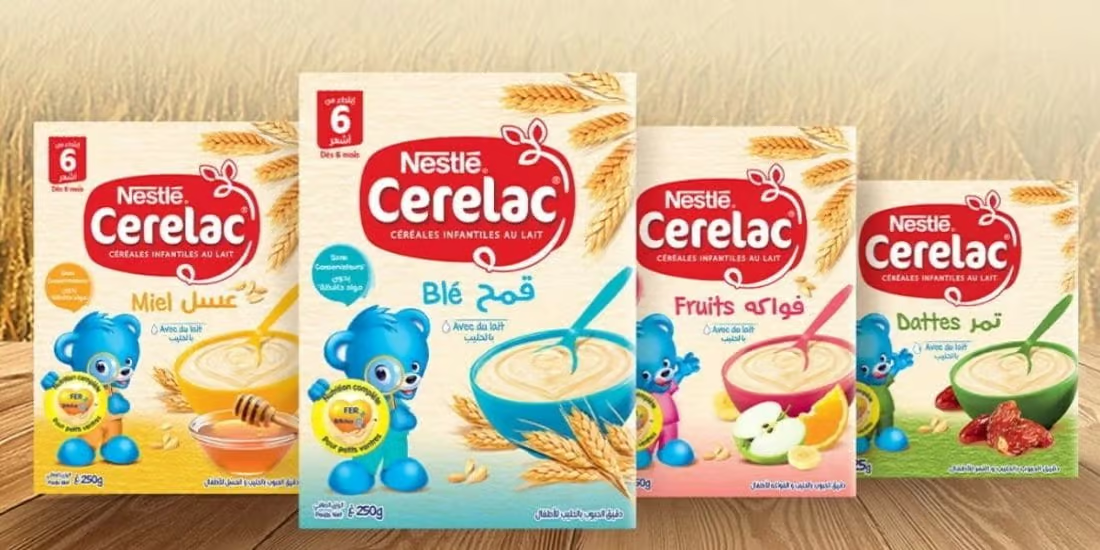
Few have captured that emotional weight as vividly as the Moroccan-Swiss essayist and human-rights activist Kacem El Ghazzali, who devoted a recent column in the Swiss magazine Schweizer Monat to the subject. Invoking Marcel Proust’s madeleine, El Ghazzali described how a handful of Swiss logos transport him back to his Moroccan childhood. There was the Cerelac box that promised healthy nutrition at home — he confessed he was long too old for the infant cereal but still secretly tasted it, even envying his younger sister her privilege of eating the creamy porridge. And there were the large yellow tins of Nido powdered milk, which, as he put it, became a lifeline in a world without refrigerators and in villages without electricity. In the 1990s, he recalled, Nido was everywhere — a Swiss product that had conquered the Arab world even though few knew where it came from.
For El Ghazzali, that ubiquity hardened into something close to collective nostalgia. “For millions of Arabs, Nido is the Proustian madeleine — a taste with the sweet smell of childhood,” he wrote, recounting an Instagram clip of an Arab shopkeeper in Zürich proudly announcing in Arabic that his store, too, stocked Nido.
The column traces how those childhood associations followed him into adulthood in Switzerland, shaping even his financial choices. When he began investing, he found his first share purchases were driven not by calculation but by feeling. “I was not investing in companies, but in memories. It was as if the puzzle pieces of my biography were finally coming together,” he wrote of buying his first Nestlé stock, recalling the small hands of his sister gripping the Cerelac spoon and the yellow Nido tins in his mother’s kitchen.
That dual identity — hard-nosed industrial player and tender object of memory — is what makes Nestlé’s Moroccan story distinctive. On one side stand the figures the company and Moroccan officials like to cite: jobs, investment, dairy-sector development, even a solar plant at the El Jadida site. On the other stands the intangible return El Ghazzali describes, a “capital of nostalgia” no stock exchange can price.
Three decades after local manufacturing began, Nestlé’s brands remain a quiet constant in Moroccan homes — proof that a company can root itself in a country not only through factories and supply chains, but through the memories it leaves on the tongue.