



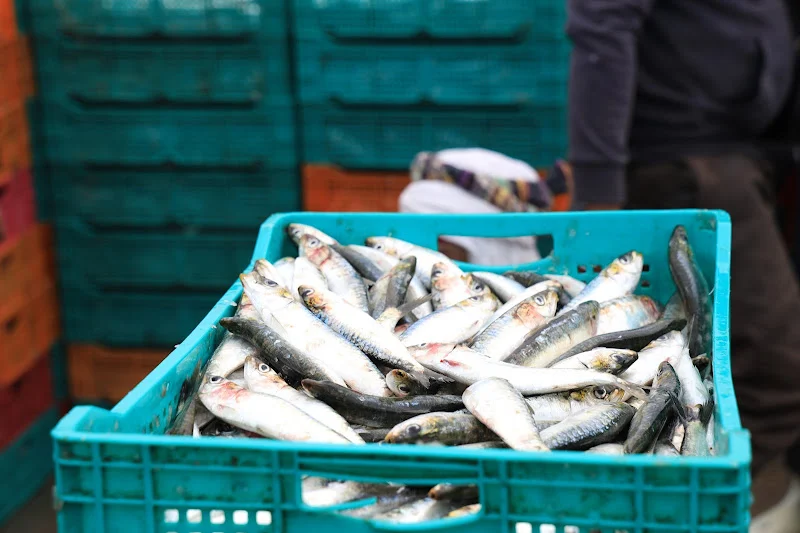
Moroccan fish traders and Spanish seafood manufacturers have opened talks aimed at softening Rabat’s ban on frozen sardine exports — a measure that has rattled one of Europe’s most important seafood supply chains.
The Aleutis Association of Fish Traders’ Friends, which represents merchants in Agadir and Laayoune, recently met with Spain’s National Association of Manufacturers of Canned and Processed Fish and Seafood (ANFACO-CYTM) to discuss possible adjustments to the export freeze, according to an industry source cited by Moroccan outlet Hespress.
The Moroccan association is now preparing a set of detailed proposals to present to the State Secretariat for Maritime Fisheries at an upcoming official meeting, the source said, while confirming that the ban remains in force.
Why Morocco pulled the plug
The freeze was announced in early January by Zakia Driouich, Secretary of State for Maritime Fisheries, as a way to boost sardine supplies in Morocco’s domestic market, where the affordable fish is a dietary staple. The decision took effect in February.
The move landed hard in Spain. Morocco is by far the largest outside supplier of frozen sardines to Spanish factories: in the first ten months of last year, Spain imported roughly 27,400 tonnes from Morocco — about 94 percent of all its frozen sardine imports from non-EU countries, according to ANFACO-CYTM.
The Spanish association has warned that cutting off supplies at that scale would have a tangible impact on factory activity and jobs in the country’s fish-processing and canning sector. It has already written to Morocco’s fisheries authorities to express its concern, suggesting that worries over the sustainability of sardine stocks could be addressed through technical solutions — potentially in cooperation with scientific bodies such as the Spanish Institute of Oceanography.
A supplier — and a competitor
The numbers illustrate an uncomfortable dual role for Morocco in the eyes of Spanish industry. The European Union is the top destination for Spanish canned sardines, yet EU countries themselves imported more than 17,000 tonnes of canned sardines from non-EU sources between January and October last year, with Morocco accounting for around 89 percent of that total.
That makes Morocco not only the main supplier of raw material to Spanish canneries, but also their most significant competitor in finished products — especially given that Spain’s own canned sardine output stood at just 13,000 tonnes in 2024.
For now, all eyes are on the upcoming meeting between Moroccan trade representatives and the fisheries secretariat, which could determine whether the ban is amended — or whether Spain’s canners will need to find new sources for one of their most essential fish.