

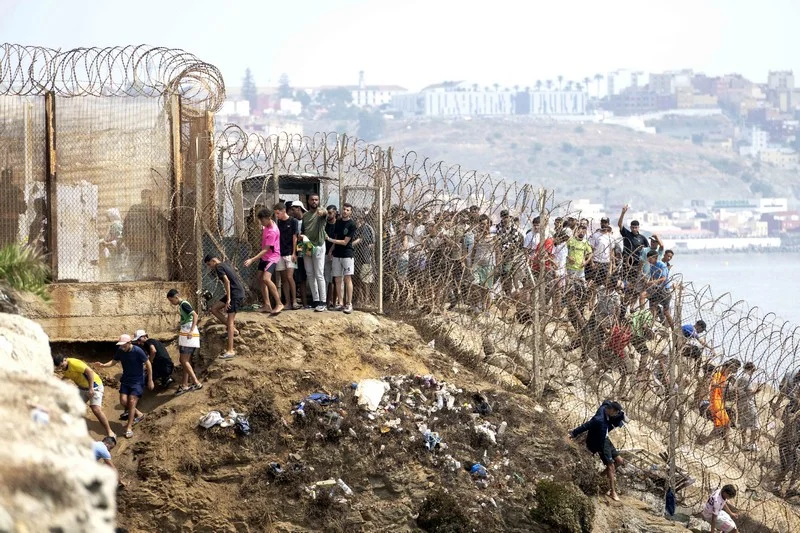
The tragic events that have unfolded at the borders around Ceuta in recent years — particularly the mass migration waves of May 2021 and July 30, 2026 — have once again placed Ceuta and Melilla at the center of Euro-Mediterranean debate. The questions they raise go far beyond migration alone. They reach into the long history of relations between Morocco, Spain, and Europe, and they open a broader question: the continuing existence of European territories on the African continent.
The human tragedy first
Before any other consideration, the human tragedies tied to attempts to cross into Ceuta and Melilla must come first. Men, women, and children have died or been injured trying to reach Europe, most often driven by poverty, despair, or the absence of economic prospects. A response cannot be limited to reinforced surveillance systems and a purely security-based approach to border management. It must also grapple with the structural causes of migration, the inequalities between the two shores of the Mediterranean, and the shared responsibility of European and African states.
The most recent Ceuta crisis illustrated this tragically. Thousands attempted to cross from Moroccan territory in a context marked by escalating diplomatic tensions in the region. The event showed how deeply the two enclaves function as a space where migration, economics, security, and diplomacy intersect — and reminded observers that Ceuta’s border is one of the most sensitive land frontiers of the European Union, despite lying geographically in Africa.
Two cities, one disputed status
Ceuta and Melilla sit on the northern coast of Africa and are currently under Spanish administration. Their status remains the subject of an ongoing political dispute between Morocco and Spain: Morocco considers the two territories part of its national unity, while Spain maintains that they are an integral part of its national soil.
This divergence cannot be understood without returning to the complex history of the European presence on the North African coast.
Ceuta’s history stretches back through antiquity and the Middle Ages, under a succession of political authorities. It was, notably, integrated into the territories ruled by the Islamic dynasties that governed the far Maghreb and al-Andalus — the Almoravid, Almohad, and Marinid periods being pivotal chapters in the political and cultural history of the region around the Strait of Gibraltar.
In 1415, the Portuguese seized Ceuta under King John I, in what is often considered a founding moment of Portuguese maritime expansion and, more broadly, of European overseas expansion. When the Portuguese Crown passed to the Habsburgs in 1580, Ceuta came de facto under Spanish rule. After Portugal recovered its independence in 1640, the city chose to remain loyal to the Spanish crown — becoming permanently Spanish, even as Portugal itself regained sovereignty.
Melilla’s story is different. Castilian forces took it in 1497, led by Pedro de Estopiñán with the backing of the Duke of Medina Sidonia. The Spanish presence there evolved along a distinct historical trajectory from that of Ceuta.
These two capsule histories show that the Ceuta–Melilla question cannot be reduced to a simple clash between two competing national narratives. It is the product of a long history of conquests, imperial rivalries, territorial reshaping, and shifts in the very concept of sovereignty. Historians like Fernand Braudel have shown how much the Mediterranean must be understood as an interconnected historical space — traversed by human, commercial, cultural, and political flows that long predate modern nation-states.
The Moroccan case: pre-colonial sovereignty
One of Morocco’s main arguments rests on pre-colonial sovereignty — on the continuity of the sultan’s authority over vast areas of the far Maghreb. Moroccan historians, notably Abdallah Laroui, have stressed the need to avoid mechanically projecting the territorial categories of the modern nation-state onto pre-colonial societies.
The observation matters. The modern European conception of borders — based on precise territorial demarcation and legally uniform jurisdiction — does not always align with the forms of sovereignty that prevailed in the greater Maghreb before colonization. The sultan’s authority was exercised in varying degrees, through relations of allegiance (bay’a), taxation, and religious and political ties, without necessarily taking the form of a uniform administrative control.
It is in this framework that Moroccan claims regarding Ceuta, Melilla, and the other Spanish holdings on the North African coast should be considered.
From independence to the present
After Morocco’s independence in 1956, the question of colonial-era borders became a significant element of national political debate. The Moroccan nationalist current, particularly within the Istiqlal Party, argued for the recovery of territories considered to have been separated from Morocco during the colonial period.
This position was part of a broader decolonization dynamic. The retrocession of Tarfaya in 1958 and of Sidi Ifni in 1969 were important milestones in consolidating the territorial unity of independent Morocco. The Moroccan Sahara — previously under Spanish administration — represents, in certain legal and political respects, a case that intersects with the question of Ceuta and Melilla.
The contemporary particularity of the two cities lies in their legal and political status: administered by Spain and integrated into the European Union, but geographically situated on the African coast. They are, therefore, exceptional points of contact between the European sphere and the African continent.
This produces a distinctive geopolitical paradox. The cities lie under Spanish sovereignty, are embedded in the European institutional framework, and are geographically surrounded by Moroccan territory. They are also important crossing points for trade, human mobility, and migration.
The migration question has consequently transformed the strategic significance of the two cities. Ceuta and Melilla have become spaces where the external borders of Europe — and the territorial legacy of colonialism — are materially embodied at once. Their function in migration control has gradually become comparable in weight to their historical and military importance.
Cooperation despite disagreement
This situation also helps explain the paradoxical nature of Morocco–Spain relations. The two states are bound by substantial economic interests, extensive commercial ties, close human links, and indispensable cooperation on security and migration — and yet the territorial dispute remains a structural source of friction.
Jaime Trinidad’s study of Moroccan claims to the Spanish territories in Africa also shows that the legal arguments vary from one territory to another, and that the strength of Morocco’s case differs between Ceuta, Melilla, the Chafarinas Islands, and Perejil Island.
More than seven decades after Moroccan independence, the Ceuta–Melilla question remains politically unresolved. Morocco continues to consider the two territories part of its national space; Spain firmly maintains its sovereignty over them.
A Gibraltar-style path forward?
The comparison with Gibraltar is often invoked in Moroccan political discourse. The process undertaken by Spain, the United Kingdom, and the European Union regarding the practical status of Gibraltar has shown that a long-standing territorial dispute can gradually be surrounded by mechanisms of cooperation and shared management — even when core positions on sovereignty remain divergent.
The lesson Morocco could draw is significant: long-running territorial disputes are not necessarily condemned to permanent deadlock. They can be handled through gradual negotiations, confidence-building measures, and cooperation mechanisms that allow, at least provisionally, questions of sovereignty to be separated from the practical necessities of daily life.
A similar approach could be imagined for Ceuta and Melilla.
Beyond fortified borders
The essential question is perhaps not only who will hold Ceuta and Melilla several decades from now, but how the two countries can build a framework that protects their mutual interests while responding to the aspirations and needs of the populations concerned.
It is equally important to recognize that migration cannot be sustainably managed through militarization of borders alone. The events of 2021 and 2026 have shown that the borders of Ceuta and Melilla can also become instruments of diplomatic pressure. Migration cooperation between Rabat and Madrid must therefore be part of a broader strategy grounded in economic development, legal mobility, the fight against criminal networks, and the protection of fundamental rights.
From this perspective, the future of Ceuta and Melilla should be considered within the wider framework of Euro-Mediterranean relations. Rather than remaining fortified borders, the two cities could become spaces of dialogue, exchange, and cooperation between Africa and Europe.
Morocco and Spain are, ultimately, condemned to coexist. Their geographic proximity, their economic and human ties, and their shared security interests make it essential to build a relationship based on trust and mutual respect. A resolution of the territorial dispute — however complex — would help open a new chapter in bilateral relations.
Morocco’s claim to Ceuta and Melilla represents a long-established political and historical position. Spain, for its part, defends a sovereign position based on its history of administration and the two cities’ legal and institutional integration into the Spanish state. Between these two positions, the moment may have come to seek a new path — based not on confrontation, but on negotiation.
The ultimate goal should be to transform what today constitutes a border of separation into a space of cooperation. Such a shift would serve not only the interests of Morocco and Spain, but also those of the European Union and the Mediterranean region as a whole.
The future of Ceuta and Melilla is unlikely to be determined by the force of historical claims alone. It will depend, above all, on the parties’ capacity to shape a political solution that takes into account history, international law, human realities, and the legitimate interests of the populations concerned.