


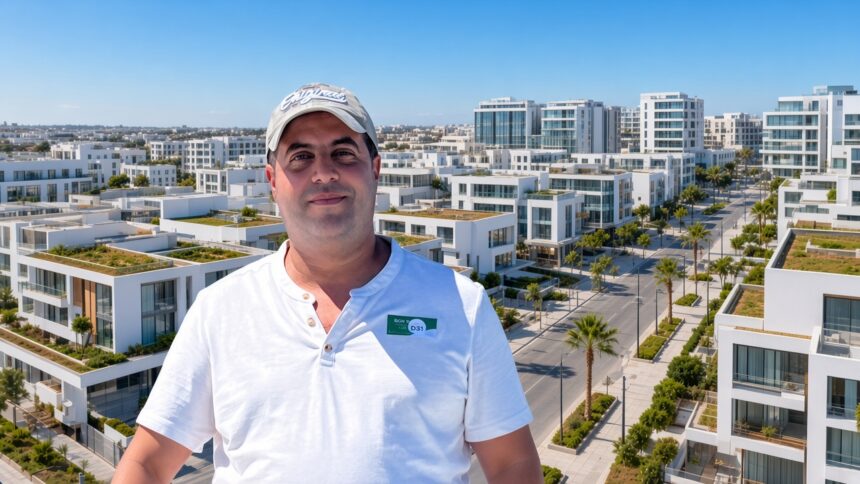
Mourad Abouyassine is a businessman from the Tamesna area, south of Rabat, who has built his career in local commerce and is now investing in a modern shopping center in the heart of the new city. He is also known for speaking openly about how local affairs are run. In a recent video series, he called on residents to vote, to choose candidates carefully and to hold elected officials accountable for how public money is spent. He also criticizes the bureaucracy of some local administrations, which he says does not match the King’s long-standing support for investors who create jobs.
Abouyassine is a familiar figure in Tamesna and the commune of Sidi Yahya Zaer, where he runs a bakery business. He often uses it as an example to explain how the real economy works: when you buy a sack of flour, you have to sell what you produce at a price that covers your workers, your costs and a fair margin. That experience shapes his view of public life. In his eyes, a commune’s budget should be managed with the same care and the same accountability as a business.
What sets him apart is that he does not stop at business. He takes a close interest in the development of his area, from the state of its roads to the way the commune collects its revenue, and he shares his views directly with residents.
A clear message to voters
In a three-part video series aimed at local residents, Abouyassine explained, in plain Moroccan Arabic, how he sees the workings of local and parliamentary elections, drawing on years of following public life in the area.
He describes three types of candidates. The first, in his view, has no job or stable income and sees an elected post as a source of personal gain. The second, which he considers the most dangerous, has major business interests that conflict with the public role. The third has a stable job, profession or business with no link to the office, and genuinely wants to serve the public. Abouyassine urges voters to support this last group.
He explains the idea of conflict of interest in simple terms. He describes how buying cheap farmland near the edge of a town can become very profitable once that land is brought into the urban perimeter or connected to roads, water and electricity, which can multiply its value. If an elected official steers municipal resources toward such land, he warns, the public budget ends up serving private interests rather than residents, while local roads remain in poor condition. He says Tamesna and Sidi Yahya Zaer have suffered from these practices during the outgoing term, and he points the finger at members of the National Rally of Independents (RNI), the party known by its dove symbol.
He also raises a concrete fiscal issue. The area around Sidi Yahya Zaer is home to more than six quarries extracting stone and marble. According to Abouyassine, they pay a local tax of about 3 dirhams per cubic meter, based on their own declarations, with little effective control. He says a neighboring commune applies a rate of about 6 dirhams, and that applying a similar rate in Sidi Yahya Zaer would bring the commune several billion centimes in additional revenue each year, money that could go toward repairing roads damaged by quarry trucks. He argues that some interests work to keep these rates low.
His conclusion is clear: staying at home on election day is a mistake. If residents do not vote, he warns, a small minority will decide for everyone, and the same problems will continue for another five years. He calls on residents to vote for parties that have done at least some work, and to demand an account of what elected officials have achieved.
Red tape that holds investment back
Abouyassine also criticizes the way some local administrations deal with investors. In his view, certain local offices remain very bureaucratic: files move slowly, procedures are complicated and decisions are delayed, while officials do little to improve the local economy or encourage investment. For an entrepreneur who wants to build, open a business and hire, he says, these delays cost time and money, and they discourage others from investing in the area.
He contrasts this attitude with the clear direction set at the highest level of the state. His Majesty King Mohammed VI has consistently supported investors who create jobs and has repeatedly called for removing the obstacles they face. In his speech to Parliament in October 2022, the King set the goal of mobilizing 550 billion dirhams in investment and creating 500,000 jobs between 2022 and 2026. This vision led to a new Investment Charter, adopted in 2022, which offers incentives to projects that create jobs and develop the regions. It also follows the 2019 reform of the Regional Investment Centers, designed to simplify procedures and speed up approvals for investors.

For Abouyassine, the problem lies in how this vision is applied on the ground. The royal guidelines are clear, he says, but some local administrations have not yet adopted the same spirit of service and efficiency. In his view, every investor who gives up because of red tape is a lost opportunity for jobs in Tamesna and Sidi Yahya Zaer.
Tamesna: a new city with strong potential
Abouyassine’s commitment comes in a city that holds an important place in Morocco’s urban strategy. Tamesna was launched in 2006 as one of the country’s first new cities, on 840 hectares, about 20 kilometers from Rabat, 8 kilometers from Temara and 15 kilometers from Skhirat. It was designed to ease pressure on the Rabat-Salé-Temara area and to offer affordable housing within a planned urban setting. It belongs administratively to the commune of Sidi Yahya Zaer, in the Skhirat-Temara prefecture.
The city is developed by the public Al Omrane Group. At full development, it is planned to house 250,000 people in 50,000 housing units. By 2020, more than 10 billion dirhams had been invested in Tamesna, and 73% of its housing had been built by private developers working with Al Omrane, showing the central role of private investors in the city’s growth.
The population has grown quickly, from about 28,000 at the 2014 census to an estimated more than 90,000 today. The city has a large urban forest, a central park, a cultural center, one of the largest mosques in the country and a local hospital. An industrial zone is also expected to create about 1,700 jobs.
Tamesna’s main challenge has long been its economic base. For years, it was criticized as a “dormitory town” where residents slept but worked, shopped and spent their leisure time elsewhere. Local businesses, shops and services are essential to changing this, because they create jobs on site and keep spending in the city. This is where private investors like Abouyassine play a key role.
His newest project: a modern shopping center in Les Jardins de Zaer

Abouyassine’s latest investment is a shopping center in the Les Jardins de Zaer district of Tamesna. The project, designed by architect Hicham Idrissi of hid architecture, rises to a ground floor plus four upper floors, with two basement levels, on a plot of about 504 square meters at the corner of a 30-meter avenue and a 15-meter street.
The building offers about 2,700 square meters of floor space above ground. Its program covers the main needs of daily life:
- Ground floor: a supermarket, a bakery with its own kitchen, and four shops
- First floor: a café-restaurant of about 208 square meters, with a terrace of about 126 square meters overlooking the street
- Second to fourth floors: about 11 shops per floor, or around 385 square meters of retail space on each level
- Two basement levels: parking for 35 cars
The architect’s renderings show a contemporary building with large glass windows, light-colored cladding and a landscaped frontage with palm trees. The plans also include a full fire-safety system, with smoke extraction, fire doors, emergency lighting and fire hoses.
For Tamesna, the project matters on several levels. It brings shopping and services within walking distance of residents, so they no longer need to travel to Temara or Rabat for everyday purchases. It offers around 40 commercial units to local traders and entrepreneurs, supporting small businesses and creating jobs. Its underground parking helps reduce congestion on the surrounding streets. And as a modern building on a main road, it contributes to the image of a city that is becoming a real urban center, not just a residential area.
The project reflects the same conviction Abouyassine expresses in public: a city develops when its people invest in it, take part in its affairs and expect results from those who manage it.