
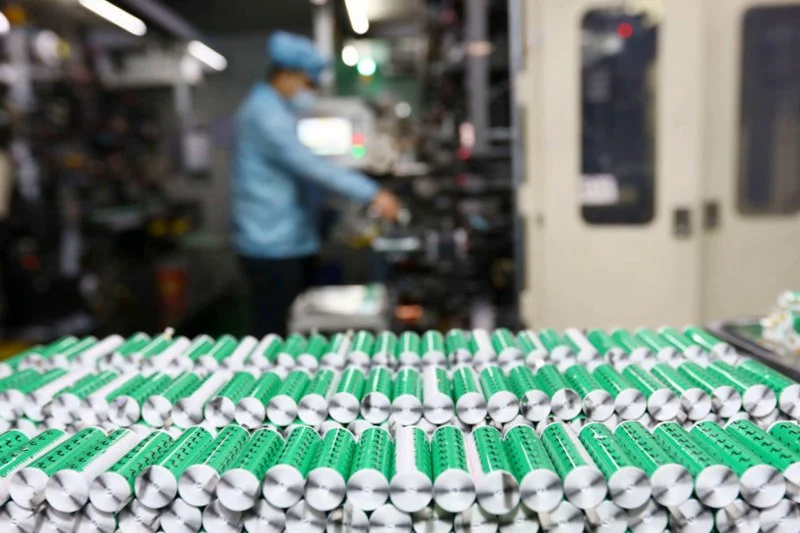
Chinese battery maker Gotion High-Tech and Volkswagen’s battery arm PowerCo plan to build a plant in Kenitra that will make up to 100,000 tonnes of lithium iron phosphate (LFP) cathode materials a year. The Moroccan site is one of three joint ventures, worth €3.22 billion in total, that the two companies are setting up across Morocco, Spain and Slovakia. Its output will feed battery cell factories in Europe.
Morocco’s place in the global electric vehicle battery industry grew this week. On September 28, Gotion High-Tech and Volkswagen announced that PowerCo and Gotion plan to set up three joint ventures in Spain, Slovakia and Morocco, with a combined investment of about €3.222 billion. Gotion’s side is contributing €1.598 billion and PowerCo’s side €1.624 billion.
The Moroccan project will cost about €480 million ($547 million), roughly 15% of the total package. Gotion will own 51% of the Moroccan joint venture and PowerCo the other 49%. To form the company, Gotion Power will create a new entity in Kenitra, and PowerCo will then inject capital into it.
A Mediterranean battery network
The Kenitra plant’s main job will be to supply Europe. The cathode materials made in Morocco will go first to the two cell joint ventures in Europe. The cells from those plants will mainly serve Volkswagen’s demand on the European market.
The two European plants are large projects in their own right:
- Valencia, Spain: a cell plant with 29.1 GWh of annual capacity, costing about €2.262 billion. PowerCo will hold 51%, and Gotion will put in about €1.1 billion for the other 49%.
- Šurany, Slovakia: an 8.4 GWh-per-year joint venture costing about €480 million, 51% owned by Gotion, making batteries for both electric vehicles and energy storage.
Together, the two European sites are planned to produce 37.5 GWh of batteries a year. Kenitra’s location helps here. The city has short sea links to Europe, and Morocco has free-trade agreements with both the European Union and the United States.
Why cathodes matter
The cathode is one of the most important parts of a battery cell. It has a direct effect on how well the cell performs, how long it lasts and how much it costs. The partners chose LFP chemistry, which carmakers are using more and more because it costs less, is more stable and lasts longer than many alternatives.
Building on the Kenitra gigafactory
The joint venture adds to Gotion’s existing investment in Morocco. The company is building what will be Africa’s first battery gigafactory in Kenitra. The plant sits in the Atlantic Free Zone, is being developed by the local subsidiary Gotion Power Morocco, and grew out of a 2023 memorandum of understanding. The first phase will cost 12.8 billion dirhams. Capacity is planned to reach 100 GWh in later phases, with total investment of 65 billion dirhams. The gigafactory is expected to create 17,000 jobs in total, counting direct, indirect and induced positions. Of these, 2,300 will be highly skilled.
The project also has strong financial support. In July, the African Development Bank approved a €100 million loan for Gotion Power Morocco to help build the integrated LFP battery project in the Rabat-Salé-Kénitra region.
The gigafactory is now close to production. According to the group, the first battery cell line is expected to start in October 2026 and a second line in November. Once both are running, Kenitra will host several stages of battery production in one industrial zone: cell manufacturing, cathode materials and related activities.
From shareholder to industrial partner
The deal also changes the relationship between the two companies. Volkswagen is already one of Gotion’s reference shareholders. Through PowerCo, it will now co-own the production plants directly. Volkswagen set up PowerCo in 2022 to run its battery business worldwide. Gotion will help develop Volkswagen’s main European cell production site. In return, PowerCo will take stakes in Gotion’s battery and materials projects in Europe and Africa, so the two can build a local battery supply network for Europe.
Gotion is growing fast. Data from SNE Research shows its global EV battery installations reached 34.0 GWh in the first seven months of 2026, 44.2% more than in the same period last year.
A growing ecosystem
The investment adds to Morocco’s automotive sector, which has expanded beyond car assembly and parts into electric vehicles, batteries and battery materials. The Ministry of Investment and the investment agency AMDIE are also working on other cathode, anode and recycling projects led by Chinese groups such as BTR and CNGR, around Kenitra and Jorf Lasfar. BTR’s agreement covers a cathode plant with 50,000 tonnes of annual capacity.
One step remains: the companies have not yet signed the final investment agreement. Even so, the Kenitra project is no longer a standalone plant. It is now part of a production network that runs from Morocco to Spain and Slovakia, which strengthens the Kingdom’s position in Europe’s battery industry.