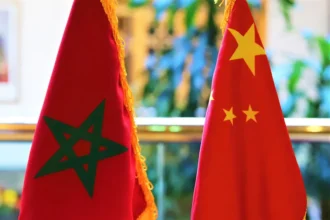

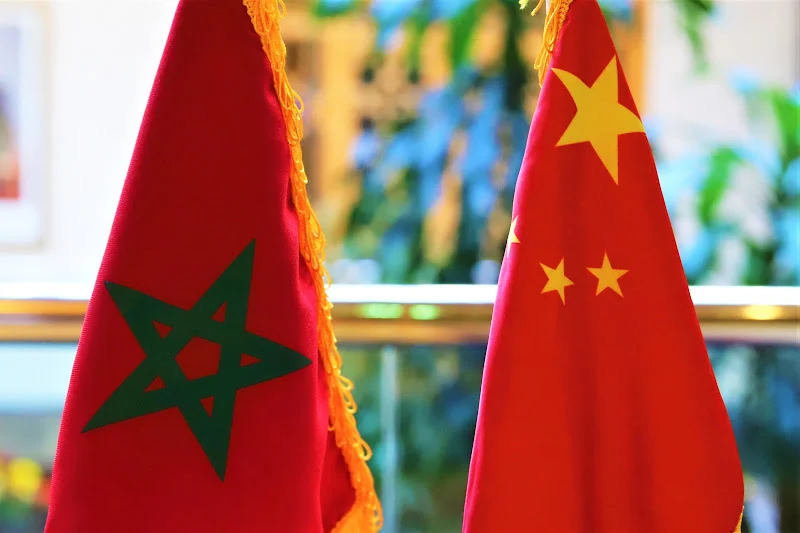
The European Union’s proposed Industrial Accelerator Act was designed with Beijing in mind — even if it never says so out loud. But when it comes to the growing web of Chinese investments in Morocco, both Moroccan and Chinese analysts believe the impact will be limited, according to Moroccan outlet Hespress.
Formally proposed by the European Commission last March, the draft law aims to shield the EU’s industrial base and reduce economic dependence on outside powers — particularly China — in critical supply chains. Experts note that several of its provisions target China without ever mentioning it by name.
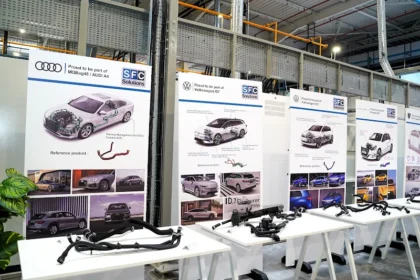
The question now is what all this means for Morocco, which has spent the past few years positioning itself as a Chinese-backed manufacturing bridge to the European market — especially in electric vehicles, batteries, and renewable energy.
“A relative challenge” — but not for Morocco
Analysts who spoke to Hespress do not deny that the law, if adopted, would create some friction. But they insist that Chinese investments in Morocco rest on a genuine complementarity between the two economies — one that Chinese players will need to defend by keeping production costs under control.
Youssef El Kerraoui El Filali, an economist and head of the Moroccan Center for Governance and Management, told Hespress he did not expect the law to hurt Morocco. The kingdom, he argued, is already embedded in production chains through a national industrial ecosystem that includes European partners and investors. An investor can, therefore, invest in the European Union and in Morocco at the same time — there is nothing preventing that.
The real challenge, in his view, is for China itself. If the EU manages to build up a strong, high-value-added industrial output of its own, questions will start to arise about how much Chinese manufacturing located in Africa is really needed to serve the European market. That is where the “relative challenge” appears.
The tariff wall — and a call for cost discipline
Filali also flagged the tariff dimension. Even if Chinese manufacturers set up shop and produce in Morocco for export to Europe, tariffs will always be applied to their products, he said. The result is intense competition that demands rigorous cost control — all the more so given the rising customs duties applied to exports bound for both the EU and the United States.
The European market, he added, has become a mature one that is now seeking to enhance its competitiveness, raise its industrial output, and cut carbon emissions.
While confirming that Chinese investments in Morocco are already anchored through concrete commitments and investment agreements, Filali cautioned that dealing with the EU requires a degree of prudence and anticipation. Chinese investors across Africa — not just in Morocco — need to understand that exporting goods from the kingdom into Europe means meeting European quality standards and specifications, and slashing carbon emissions to very low levels in line with the EU’s industrial-acceleration legislation.
Cost control, he stressed, is essential in this equation: once tariffs are applied, the final cost of the product must remain reasonable so that companies can set a competitive selling price and preserve their margins.
Beijing’s confidence — built on complementarity
The view from the Chinese side is equally sanguine. Nader Rong Huan, a Chinese economic analyst and board member of the Chinese Association for Middle East Studies, told Hespress he did not believe the draft European industrial-acceleration law would weaken Chinese investor confidence in Morocco or dent Sino-Moroccan cooperation in economics, trade, and manufacturing.
Cooperation between China and Morocco — like Chinese investments in the kingdom — is built on the complementarity of each country’s advantages, Huan explained. In the case of electric vehicles and renewable energy, China brings highly competitive industrial capacity, while Morocco brings geographical advantages and rich reserves of minerals and raw materials.
Those elements, he concluded, confirm that China’s leadership in industrial investment in Morocco is not something that can be reversed by the adoption of the European draft law.
The wider game
The picture that emerges is one of measured confidence layered over quiet caution. Neither side is dismissing the possibility that Brussels’ push for industrial autonomy will complicate the Chinese playbook in Africa. But both insist that Morocco’s specific value proposition — its trade agreements with the EU, its geography, its industrial ecosystem, and its raw materials — will keep the kingdom on Chinese investors’ maps, provided they can play by Europe’s tightening rules on standards, emissions, and cost.
If they can, Morocco stands to remain the corridor. If they cannot, the Industrial Accelerator Act will have delivered exactly the kind of pressure Brussels was hoping to create — not on Morocco, but through it.