
For Morocco’s leaders, the 2030 FIFA World Cup, co-hosted with Spain and Portugal, is a national project and a showcase for a rising African economy. For a large part of the country’s youth, it has become a symbol of misplaced priorities. Less than four years before the tournament, the debate over who pays and who benefits is far from settled.
“Stadiums are here, but where are the hospitals?”
The criticism burst onto the streets on 27 September 2025, when a leaderless youth collective calling itself Gen Z 212, after Morocco’s international dialling code, called for protests in some ten cities. Organised largely on the chat platform Discord, where it quickly gathered more than 200,000 members, the movement was triggered by the deaths of eight women in childbirth at a public hospital in Agadir. Its demands focused on health care, education and the fight against corruption.
The slogan that defined the protests directly targeted the World Cup: “Stadiums are here, but where are the hospitals?” Other chants called for “health first” instead of the tournament, and some activists urged a boycott of both the 2025 Africa Cup of Nations and the World Cup. Protesters pointed out that Morocco’s health system lags behind those of countries with similar income levels, even as new stadiums rise in Rabat, Tangier and near Casablanca.
The movement was mostly peaceful, but violence broke out on several nights. Three people were killed near Agadir in clashes with police, who said they acted in self-defence. More than 2,400 people were charged, and courts in Agadir and Marrakech handed down heavy prison sentences to dozens of defendants, although some sentences were later reduced on appeal. Human rights groups, and even at least one lawmaker from the governing majority, criticised what they saw as an excessive security response.
A soaring bill
At the heart of the debate is money. Morocco is building new stadiums and renovating existing ones, alongside airport expansions, a southern extension of its high-speed rail line and new roads. The centrepiece is the Grand Stade Hassan II in Benslimane, between Casablanca and Rabat, designed to hold around 115,000 spectators and become the largest football stadium in the world. Its cost has risen from an initial 5 billion dirhams to about 13.6 billion dirhams, according to an assessment of public contracts, and completion is now expected in early 2028.
Fouzi Lekjaa, president of the Royal Moroccan Football Federation and of the 2030 World Cup committee, insists the stadium should host the final — an ambition contested by Spain, which wants the final played in one of its own stadiums. For critics, the rising price tag of a stadium that may be used only occasionally after 2030 is exactly the problem.
The government’s case
The authorities reject the idea that the World Cup is crowding out social spending. Officials have argued that the problems in the health sector were inherited from the past, and that most of the World Cup budget goes to transport infrastructure that Moroccans will use for decades. According to the International Monetary Fund, rail accounts for around half of the planned investment, airports for about a fifth and stadiums and construction for less than a fifth.
The government estimates that co-hosting will add about 1.7% to growth and create more than 100,000 jobs a year. The IMF has forecast that the investment drive could leave the Moroccan economy around 2% larger by 2030 than it would otherwise have been, but warned that the gains depend on efficient execution, cost control and careful management of fiscal risks, as public spending rises.
After a speech by King Mohammed VI calling for faster progress in the social sectors, the government also increased health and education spending in the 2026 budget. The health budget rose to 42.4 billion dirhams in 2026, more than double its 2021 level, and dozens of hospital projects are under way. The protests gradually lost momentum after these announcements.
Other controversies
The World Cup has drawn criticism from abroad too. International animal welfare groups have accused Moroccan authorities of mass culling of stray dogs to “clean up” cities before the tournament, and have lobbied FIFA to intervene. Moroccan officials deny any eradication campaign and have pointed to a programme of around $100 million to manage stray animals humanely. Rights organisations have also raised wider concerns about freedom of expression and assembly in all three host countries.
A political test
The discontent has had political consequences. Turnout in the legislative elections of 23 September 2026 fell to 38%, its lowest level in two decades, and the outgoing head of government’s party, the RNI, lost more than a third of its seats. The new government of Fatima Ezzahra El Mansouri now has to oversee the final stretch of preparations — and convince a sceptical generation that the World Cup will bring them better hospitals, schools and jobs, and not just stadiums.
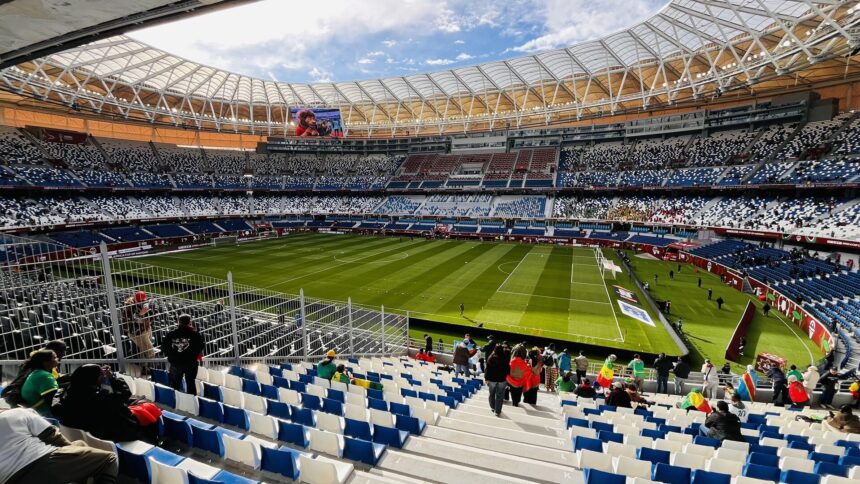
Supporters of the tournament argue that Morocco has already shown what it can deliver, with the hosting of the 2025 Africa Cup of Nations and the opening of new venues such as the rebuilt Prince Moulay Abdellah Stadium in Rabat. Critics reply that the real measure of success will not be the opening ceremony in 2030, but whether ordinary Moroccans feel the benefits long after the last match.
Photo: Ymax2016 / Wikimedia Commons (CC0)