

Morocco is about to cross a symbolic economic line. According to the International Monetary Fund’s October 2026 World Economic Outlook, the country’s nominal gross domestic product per person will reach about $5,140 in 2026, the first time it has passed the $5,000 mark. The milestone, reported by Hespress on November 18, comes as forecasters publish sharply different views on what happens next.
From $3,500 to $5,000 in twelve years
The IMF figures show a steady climb. Morocco’s GDP per capita stood at roughly $3,526 in 2014, rose above $4,000 in 2024 and came close to the threshold in 2025, at about $4,971. That is a gain of around 41% in dollar terms over twelve years, interrupted only by the Covid-19 slump of 2020. The IMF expects total output of about MAD 1.83 trillion in 2026, or roughly $194 billion, for a population of about 37.25 million.
The new level places Morocco in a cluster of lower-middle-income peers. The IMF projects about $5,260 per person for Vietnam in 2026, $5,050 for Tunisia and $4,020 for Egypt. Morocco therefore sits just behind Vietnam, a country many investors use as a benchmark for export-led manufacturing, and ahead of Egypt.
A caveat matters here. GDP per capita measures average economic output, not what households actually earn or spend. It also moves with the exchange rate: part of the rise reflects a stronger dirham against the dollar, not only real growth.
What is driving the climb
The increase reflects a wave of public and private investment: World Cup 2030 transport and stadium projects, new automotive and battery plants, renewable energy and desalination. That investment cycle is visible in the banking data. As we reported, bank lending grew 12% in the year to September, with equipment loans up by a third. Tourism receipts, industrial exports and a recovery from the drought years of 2022 and 2023 have also helped.
2026: growth between 4% and 5%
For this year, the main forecasts are close to each other:
- High Commission for Planning (HCP): 4.8%, according to its July 2026 economic budget.
- IMF: 4.5%.
- OECD: 5%, in its June 2026 Economic Outlook.
- Capital Economics: 4%, the most cautious of the group.
The gap reflects how each institution weighs the energy shock that pushed up oil and gas prices this year. Morocco imports almost all of its energy, so higher prices raise the import bill and squeeze companies and households. The World Bank noted that the trade deficit widened by almost 24% in the first quarter of 2026 as imports grew far faster than exports. Motorists felt it directly: diesel rose by MAD 1 a litre on November 1, before a small cut of MAD 0.20 on November 16.
2027: rebound or slowdown?
The real disagreement is about next year.
The optimistic case. In a note published on November 17, London-based Capital Economics said Morocco had weathered the energy shock relatively well and is well placed to rebound in 2027–28. It expects growth to accelerate to 4.8% in 2027 as energy prices ease, lifting both household spending and the trade balance.
The cautious case. The HCP takes the opposite view. Its July projection sees growth slowing to 3% in 2027, assuming an average harvest after a strong year for agriculture. The OECD sits in between at 3.9%. It also warned that prolonged geopolitical tensions could hurt exports and disrupt supply chains, especially in fertilisers, one of Morocco’s most important export industries.
The swing factor, as so often in Morocco, is partly the weather. Agriculture still accounts for a large share of jobs, and a dry winter can take a percentage point or more off growth. Energy prices are the second variable, and the third is whether the World Cup investment programme stays on schedule and on budget.
What it means for investors
For foreign investors, the per-capita milestone is mostly a signal of direction: a larger, richer domestic market for consumer goods, retail, banking and housing, and an economy that keeps growing faster than its main European trading partners. Forecasts of 3% to 5% growth also compare well with the euro area.
The risks are just as clear. Morocco’s dependence on imported energy shows up quickly in its trade figures, as our report on the widening trade deficit showed. Unemployment remains high, especially among young people, and average figures hide deep regional inequality, a gap we explored in our analysis of the 4.75 million Moroccans living close to poverty. Crossing $5,000 per person is a real achievement; turning it into higher incomes for most households is the harder part.
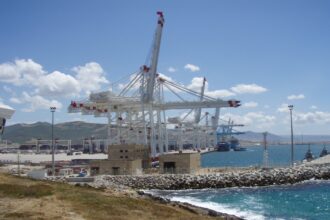
Photo: elchicogris / Wikimedia Commons (CC BY-SA 2.0)