
Three and a half hours after leaving Paris, London or Zurich, you step out into a city that has been a crossroads of caravans, dynasties and storytellers for almost a thousand years. Marrakech is not simply Morocco’s most popular destination — it is one of the few places in the world where a short-haul flight delivers a genuinely different civilisation, with palaces, gardens, mountains and desert all within a day’s reach.
The numbers show how many people have discovered it. Marrakech recorded about 7.17 million overnight stays in classified accommodation in the first half of 2026, up 10% on a year earlier and roughly one-third of the national total. Its Menara airport passed 10 million passengers for the first time in 2025, and by September 2026 it was handling an average of 798 flights a week, against 550 a year before. Here is what makes the city exceptional.
A square that UNESCO listed as a performance
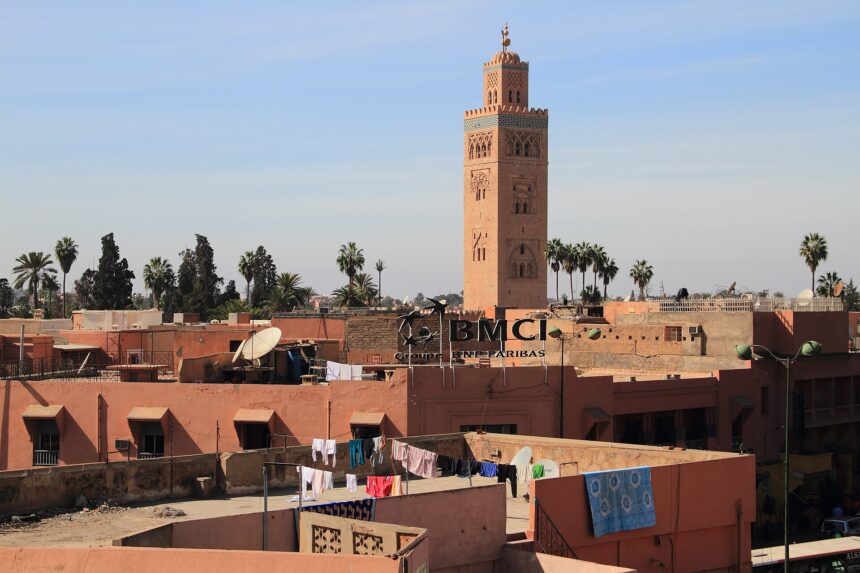
Founded by the Almoravid dynasty around 1070, Marrakech gave its name to the whole country — “Morocco” comes from it. Its walled medina has been a UNESCO World Heritage Site since 1985, and at its heart lies Jemaa el-Fnaa, a square UNESCO recognised not for a building but for what happens on it: storytellers, gnawa musicians, acrobats, henna artists and, as the sun sets, rows of smoking food stalls. Watching the square fill up from a rooftop café, with the 77-metre Koutoubia minaret glowing behind it, is one of the great travel moments anywhere.
Palaces, madrasas and gardens
Within walking distance of the square lie the Bahia Palace with its painted cedar ceilings, the Ben Youssef madrasa with its carved stucco courtyard, the Saadian Tombs and Le Jardin Secret, a restored riad garden in the middle of the medina. In the modern Gueliz district, the cobalt-blue Jardin Majorelle and the Yves Saint Laurent Museum, opened in 2017, tell the story of the designer who made Marrakech his second home. Tickets for Majorelle cost about 150 dirhams (around €15) and must be booked online in advance; the YSL Museum costs a similar amount.
Sleeping in a riad
Marrakech’s most distinctive hotels are its riads: traditional houses built around an inner courtyard with a fountain or plunge pool, hidden behind blank walls in the medina’s lanes. Hundreds operate as guesthouses, from simple family homes to designer hideaways with rooftop terraces. At the top end, legendary hotels such as La Mamounia and the Royal Mansour, and newer arrivals such as Nobu, have made the city a fixture of luxury travel; the Delano Hotel & Residences announced in 2026 is planned for 2030.
A kitchen of its own
Marrakech has its own signature dish, tanjia: beef or lamb slow-cooked for hours in a clay urn in the embers of a hammam furnace. Add tagines, couscous on Fridays, whole roast lamb in Mechoui Alley next to Jemaa el-Fnaa, fresh orange juice for a few dirhams and endless glasses of mint tea. The city’s restaurant scene now ranges from street stalls to rooftop fine dining, and cooking classes in riads are among the most popular experiences for visitors.
The souks and the hammam
The souks north of the square are organised by trade: leather, brass lanterns, carpets, spices, babouche slippers, dyers’ lanes heavy with colour. Bargaining is expected and part of the fun. After a day in the lanes, a traditional hammam — steam, black soap and a vigorous scrub — is the local way to recover, whether in a neighbourhood bathhouse or a hotel spa.
Mountains and desert on the doorstep
What really sets Marrakech apart is what lies around it. On clear days the snow-capped High Atlas fills the horizon. In about an hour and a half you can be in Imlil, the starting point for Mount Toubkal, at 4,167 metres the highest peak in North Africa, or in the green Ourika Valley. The stony Agafay desert, around 40 kilometres away, offers camel rides, quad tours and luxury camps under the stars. The Ouzoud waterfalls and the Atlantic port of Essaouira, about three hours away, make easy day trips.
Sunshine when Europe is grey
Marrakech has around 300 days of sunshine a year. Spring and autumn are ideal, with warm days and cool evenings. Winter brings bright days of around 18–20°C, which explains the rush of Europeans in November to February, although nights can be cold. July and August can exceed 45°C, so summer visitors should plan early starts and pool time in the afternoon.
Easy to reach, easy to combine
Royal Air Maroc and low-cost airlines including Ryanair, easyJet — which opened its first African base at Menara in 2026 — and Transavia fly to Marrakech from dozens of European cities. Most Western visitors, including citizens of the EU, Switzerland, the UK, the US and Canada, need no visa for stays of up to 90 days. The euro trades at around 10.5 dirhams, and a high-quality holiday still costs noticeably less than in many Mediterranean resorts.
Practical tips
- Book Majorelle, the YSL Museum and popular restaurants in advance, especially between October and April.
- Agree taxi fares before getting in, or use the meter in petit taxis.
- Carry some cash: many small shops and stalls do not take cards.
- Dress modestly in the medina and ask before photographing people.
- Read our guide Is Morocco safe? for an honest look at the risks.
Why investors are watching too
The holiday boom is also an investment story. According to Knight Frank, prime residential values in Marrakech have risen 16% since 2023, and the buyer profile is shifting from retirees to younger, internationally mobile families looking for a second base. New hotels, a growing airport and the 2030 World Cup are adding to the momentum. For many visitors, the first holiday in Marrakech is the beginning of a longer relationship with the Red City.
Photo: Schorle / Wikimedia Commons (CC BY-SA 4.0)