

Board the Al Boraq in Tangier and you can be in Casablanca in a little over two hours, gliding at up to 320 km/h on Africa’s only high-speed line. Drive a few hours south-east into the High Atlas, and the road may run out before the nearest secondary school or maternity ward comes into view. This is the paradox Morocco’s glossy investment brochures rarely mention: a country racing towards the 2030 World Cup with world-class infrastructure, while millions of its citizens live one bad harvest, one hospital bill or one lost job away from poverty.
The good news Morocco likes to tell
Let’s be fair: the headline numbers are genuinely impressive. According to the High Commission for Planning (HCP), the national statistics agency, absolute poverty collapsed from 15.3% of the population in 2001 to just 1.7% in 2019. Extreme poverty was down to 0.3% by 2022. In 2023, Morocco joined the club of countries with “high human development” in the UN’s index, scoring 0.710. Measured by deprivation in health, education and housing, the share of poor Moroccans fell from 11.9% to 6.8% between the 2014 and 2024 censuses — about 1.5 million people lifted out of multidimensional poverty in a decade.
Few countries in the region can claim a record like that. So why are so many Moroccans angry?
The number that should keep policymakers awake
Because the averages hide a fragile middle. The pandemic, the inflation shock that followed the war in Ukraine and years of drought undid part of the progress in a few short years. Absolute poverty climbed back to 3.9% in 2022, according to the HCP’s latest household survey — more than double the 2019 level. In the cities, it actually rose compared with 2014, from 1.6% to 2.2%.
The figure that matters most, though, is not the poor but the nearly-poor. In 2022, 12.9% of the population was classified as economically vulnerable, up from 7.3% just three years earlier. That is around 4.75 million people — more than the entire population of the city of Casablanca — living close enough to the line that a single shock could push them over. And for the first time, the HCP warned, this risk of sliding down the social ladder is as present in the cities as in the countryside, hitting families who earn too much to qualify for aid but too little to absorb a crisis.
Two Moroccos
Geography still decides a child’s chances. In 2024, rural multidimensional poverty stood at 13.1%, more than four times the urban rate of 3%, and 72% of the country’s poor lived in the countryside. The average rural household earned 56,047 dirhams a year, barely half the 103,520 dirhams earned by an urban household. Fès-Meknès, home to one of the kingdom’s most celebrated imperial cities, had the highest monetary poverty rate of any region in 2022, at 9%.
The contrast is brutal. The same country that is building what it hopes will be the largest football stadium on the planet still has mountain villages where drought has wiped out harvests and decimated herds, and where reaching a doctor can mean hours on unpaved roads.
Growth for whom?
Even Morocco’s central bank is sounding the alarm. In its 2025 annual report, Bank Al-Maghrib noted that the improvement in economic indicators had not been reflected to the same extent in people’s living conditions. The economy grew by a healthy 4.9% in 2025 and created 193,000 jobs, yet unemployment barely moved, from 13.3% to 13%. More than one in three young people in the labour force — 37.2% — had no job, and around 3 million young Moroccans were neither working, studying nor in training.
Then there is the question of who benefits from public money. According to the same report, the richest fifth of households spend more than seven times as much as the poorest fifth. Much of the 18 billion dirhams spent on consumer subsidies ends up helping better-off families, and tax exemptions cost the state more than 32 billion dirhams a year. Put another way: the state gives up more in tax breaks every year than twice the cost of the Grand Stade Hassan II, the giant World Cup stadium under construction near Casablanca.
Cash transfers: lifeline or sticking plaster?
The government’s answer has been to build a welfare state almost from scratch. Under a royal social protection project, compulsory health insurance was extended to millions of Moroccans who had none, and a direct cash-aid programme was launched in December 2023. By the end of 2025, according to the National Agency for Social Support, it had distributed 51 billion dirhams to nearly 4 million households, 60% of them in rural areas.
It is a real achievement — and an incomplete one. Monthly payments range from 500 to around 1,350 dirhams per family, modest sums at a time when food prices rose by 3.1% in 2025 alone. Eligibility depends on an algorithmic score in the Unified Social Registry, and some families have complained of being left out. The new government of Fatima Ezzahra El Mansouri, sworn in in October 2026, has promised to double the minimum monthly payment to 1,000 dirhams. Cash, however, does not create jobs, build schools or bring a clinic to a mountain village.
Stadiums or hospitals?
In the autumn of 2025, the young people of the Gen Z 212 movement put the question bluntly on the streets of Rabat, Casablanca and Agadir: “Stadiums are here, but where are the hospitals?” The cost of the flagship Grand Stade Hassan II alone has climbed to about 13.6 billion dirhams — more than a quarter of everything the direct-aid programme paid out in its first two years.
That comparison is not entirely fair: infrastructure and welfare are funded differently, and the World Cup may well bring jobs and investment. But it captures the frustration of a generation that sees bullet trains and stadiums rising while its own prospects stall. Morocco has proved it can build world-class infrastructure on time. The real test of the next decade is whether it can deliver the same ambition for the 4.75 million people living on the edge — before their patience runs out.
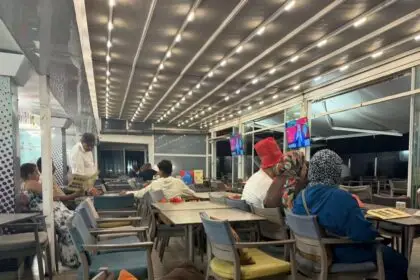
Photo: Mounir Neddi / Wikimedia Commons (CC BY-SA 4.0)