
Key points
- On 18 November 2026, Morocco presented a roadmap, branded the “Morocco Offer”, to build a national defense and security industry.
- By 2035 the plan aims to cover about 40% of the needs of the Royal Armed Forces (FAR) and security services, create nearly 50,000 direct and indirect jobs and earn more than 65% of sector revenue from exports.
- The Hassan II Fund for Economic and Social Development will contribute 4 billion dirhams (roughly $400 million). A strategic agency, an industrial holding company and a specialised academy are planned.
- Two new defense industrial zones are planned at Ben Guerir and Benslimane, in addition to the two already launched at Nouaceur and Sidi Yahya.
Morocco has spent decades buying almost all of its major military equipment abroad. It now wants to make a large share of it at home, and to sell abroad most of what its new factories produce. The roadmap presented at the Royal Palace in Rabat on Wednesday, in a working session chaired by King Mohammed VI, puts numbers, money and institutions behind an ambition that has been building since 2020. For foreign manufacturers, suppliers and investors, it is one of the clearest signals yet of where Moroccan industrial policy is heading next.
What was announced
According to the Royal Cabinet communiqué, as reported by Le Matin and Le360, the national defense industry should by 2035 meet roughly 40% of the needs of the FAR and the security services, generate close to 50,000 direct and indirect jobs, and make more than 65% of its revenue on export markets. The plan was presented by General Mohammed Berrid, Inspector General of the FAR, and Ali Seddiki, director general of the investment agency AMDIE, The Rio Times reported. The King asked for fast implementation, starting with the governance bodies and the financing plan, and called for simpler investment procedures and greater involvement of Moroccan private companies.
The strategy rests on four pillars, Le360 reports:
- A strategic agency to set the sector’s direction and support investors.
- An industrial holding company to structure the ecosystem, raise public and private capital and grow national champions.
- A specialised academy for defense-industry skills, working with manufacturers and drawing on civilian, military and diaspora expertise.
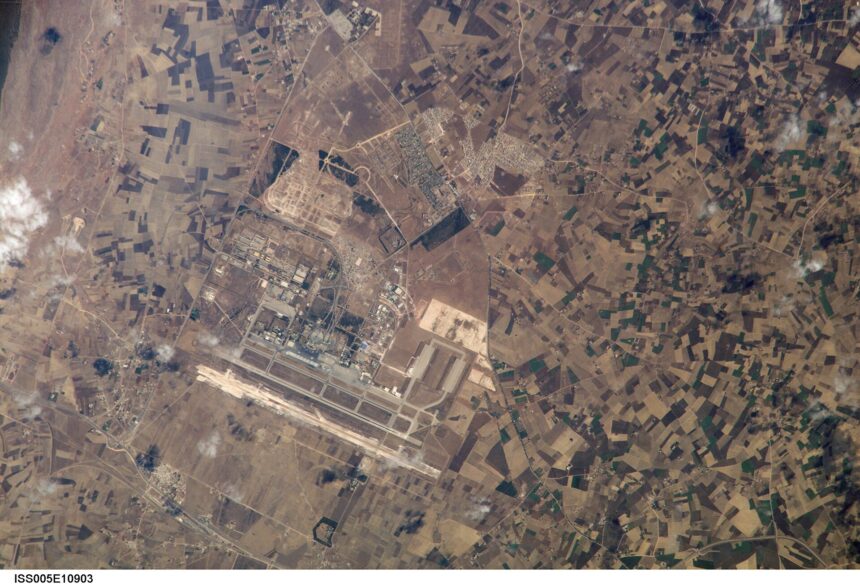
- New industrial land: two defense industrial acceleration zones are already launched, at Nouaceur and Sidi Yahya, and two larger zones are planned at Ben Guerir and Benslimane.
Funding starts with 4 billion dirhams from the Hassan II Fund. At about 10 dirhams to the dollar, that is roughly $400 million. The roadmap names drones and autonomous systems, land and naval systems, defense electronics, cyberdefense and artificial intelligence as priority segments, all areas with civilian as well as military uses.
The “Morocco Offer” label is not new. Rabat already used it for its green hydrogen programme, under which land and incentives are allocated to selected investors. Applying it to defense points to a similar model: the state defines the framework and the sites, and invites partners in.
What already exists
The roadmap builds on a legal base and a handful of working projects. Law 10-20 on defense and security equipment, weapons and ammunition, adopted in 2020, opened the sector to licensed manufacturers. A dedicated company was later set up to manage the defense zones.
The flagship project so far is Indian. Tata Advanced Systems opened a plant in Berrechid, near Casablanca, on 23 September 2025 to build the WhAP 8×8 wheeled armoured vehicle, with India’s defence minister Rajnath Singh attending the inauguration, Morocco World News and Yabiladi reported. Local content starts at about 35%, with a target of 50%, according to Le360. Le360 also lists 30 mm turrets for these vehicles in the Nouaceur ecosystem, medium- and large-calibre ammunition at Sidi Yahya, and drone manufacturing and maintenance at Benslimane. Turkey’s Baykar set up a Moroccan subsidiary, Atlas Defense, in 2025 to design, build and maintain drones.
In November 2025, Abdeltif Loudiyi, the minister delegate in charge of the National Defense Administration, told parliament that ten defense-industry projects worth about $260 million and more than 2,500 direct jobs had been approved or were close to approval, Morocco World News reported at the time.
Why it matters for foreign investors
Morocco has used the same playbook before. Dedicated zones, tax and customs incentives and one or two anchor investors turned the country into a major exporter of cars and aircraft parts, a story we have followed in our coverage of Morocco’s car exports and Europe’s “Made in Europe” rules and of the Gotion and PowerCo battery plant in Kenitra. Defense now joins the list of sectors Rabat wants to scale.
Three groups could see opportunities. First, manufacturers that sell to the FAR may face stronger pressure, or incentives, to localise production and transfer technology. Second, suppliers of components, machining, electronics, composites and maintenance services already present in the automotive and aerospace clusters could find new customers. Third, the planned holding company is explicitly meant to bring in private capital, which may open the door to joint ventures with foreign partners.
The export target is the most ambitious part. Selling more than two-thirds of output abroad would require Morocco to win orders in Africa and beyond, and to manage export licensing, end-user controls and, for foreign partners, their home governments’ rules on re-exports. For background on Morocco’s place in the arms market, see our analysis of whether France can finally sell the Rafale to Morocco.
What is still unknown
The announcement leaves several open questions. The communiqué gives no baseline for how much of the FAR’s equipment is made in Morocco today, so the size of the jump to 40% is hard to judge. No timetable has been published for creating the agency or the holding company, and there is no breakdown of how the 4 billion dirhams will be spent. The 40% and 65% figures are projections, not commitments. Many institutional investors also apply ESG screens that exclude weapons production, which could limit the pool of private capital the holding company can attract.
What is clear is the direction. After cars, aircraft parts and batteries, Morocco is betting that defense manufacturing can become its next industrial cluster, with Nouaceur, Sidi Yahya, Benslimane and Ben Guerir as the places to watch.