

Key points
- Banque Populaire’s model was born with a royal decree of 25 May 1926, which makes 2026 the hundredth year of Morocco’s cooperative banking system.
- The group is still unusual: the listed Banque Centrale Populaire (BCP) and eight regional Banques Populaires own each other, a structure that blends a cooperative network with a stock-market company.
- It has served Moroccans abroad since the 1960s and says it holds more than 52% of that market, a key channel for remittances that topped 122 billion dirhams in 2025.
- Since 2012 it has built a sub-Saharan network, and in December 2025 it took full control of Atlantic Business International, which runs ten banks across West and Central Africa.
- At the end of September 2026, group net income was up 11.2% to 5.8 billion dirhams, helped by a sharp fall in the cost of risk.
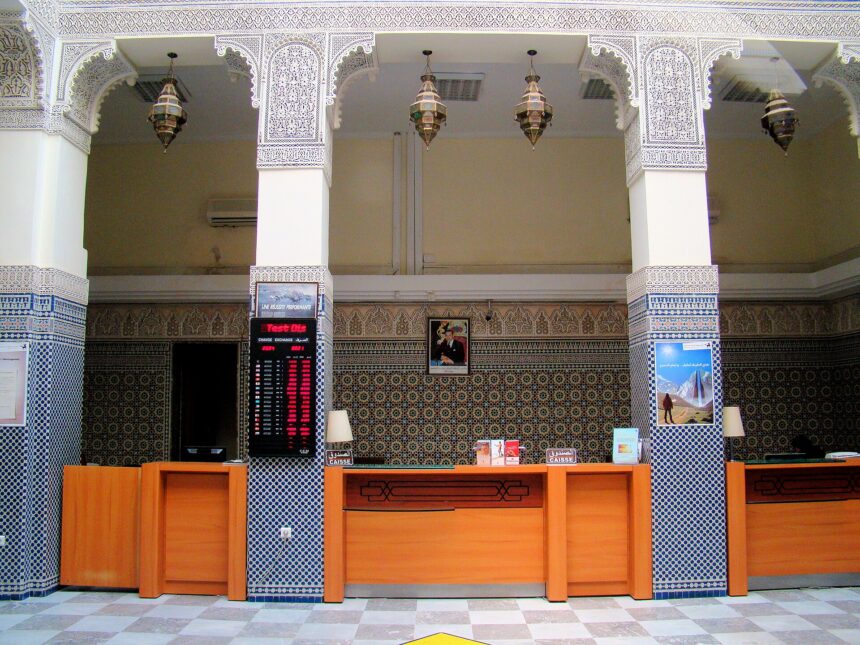
Foreign visitors to Morocco tend to notice the brown-and-orange Banque Populaire signs in every town before they know anything about the bank behind them. That bank is worth knowing. Banque Populaire, run by Groupe Banque Centrale Populaire (BCP), is Morocco’s second-largest banking group, the dominant bank for the millions of Moroccans who live abroad, and one of the biggest Moroccan investors in sub-Saharan Africa. It is also built on a structure few listed banks anywhere still use: a cooperative network that owns most of the company that sits at its centre.
A century-old idea
The group traces its model to a dahir, or royal decree, of 25 May 1926, which introduced cooperative and mutual credit to Morocco. The first regional Banques Populaires opened in major cities at the end of the 1920s, according to the group’s official history. The idea was simple: pool the savings of craftsmen, shopkeepers and small firms so they could borrow on fair terms.
After independence, a dahir of 28 February 1961 rebuilt the system. It refocused Crédit Populaire du Maroc on artisans and small and medium-sized businesses, created regional banks, and set up a central institution, the Banque Centrale Populaire, together with a management committee to coordinate the network. That three-part design, regional banks, a central bank and a federating body, still defines the group today.
Cooperative and listed at the same time
Over the following decades the state stepped back. BCP became a joint-stock company in 2000, was partly privatised through a listing on the Casablanca Stock Exchange in 2004, and in 2014 the state sold its remaining stake to the regional banks. A 2015 restructuring brought the group closer to a conventional commercial bank.
The result is a cross-ownership structure. BCP holds a majority, around 51% to 52.5% as of 2022, of each of the eight regional Banques Populaires, while the regional banks together own a majority of BCP. For outside shareholders who buy BCP shares on the exchange, this means a stable controlling block and a strong regional footprint, but also a governance system that is more complex than that of a typical listed bank. Readers new to the Moroccan market can start with our guide to the MASI and how foreigners can invest.
The bank of Moroccans abroad
What sets Banque Populaire apart most is its link with the diaspora. In the 1960s, as Moroccan workers moved to France, Belgium, the Netherlands and Germany, the bank was asked to meet their basic banking needs. In 1972 it opened a Paris subsidiary that operates under the Chaabi Bank brand. Today it says it has more than one million customers among Moroccans abroad and more than 52% of that market, with a presence across Europe, the Middle East and North America, Financial Afrik reported on the bank’s 60th anniversary of diaspora service in 2024.
The scale of that business is easier to grasp next to the national figures. Moroccans abroad sent more than 122 billion dirhams home in 2025, up 2.6% on 2024, according to the Office des Changes as reported by Hespress. Those transfers are one of Morocco’s biggest sources of foreign currency, and they give the bank a large, loyal deposit base that is relatively cheap to fund. Competition is intensifying, with rivals and money-transfer firms chasing the same flows, as our report on BCP and Western Union’s real-time transfers showed.
The African bet
The second pillar of the group’s story is sub-Saharan Africa. In 2012 BCP acquired a stake in the Atlantic banking group, whose Banque Atlantique subsidiaries operate in French-speaking West Africa. It later added BICEC in Cameroon, BMOI in Madagascar, BCI in the Republic of the Congo and other units, alongside older subsidiaries such as Banque Populaire Maroco-Centrafricaine, set up in Bangui in 1990.
On 24 December 2025 the group completed that strategy’s latest step, buying the remaining 20.17% of Atlantic Business International (ABI) from the pan-African fund Development Partners International for 1.88 billion dirhams, Le Matin reported. BCP now owns 100% of ABI, which runs ten commercial banks and four insurance companies across nine sub-Saharan countries, serves about 885,000 customers and had a loan book of 38.9 billion dirhams at mid-2025. Le Matin described ABI as the fifth-largest banking group in West Africa and put BCP’s overall presence at 32 countries.
The logic follows Morocco’s wider diplomatic and trade push into Africa: West Africa’s monetary union offers growth, a shared currency pegged to the euro, and a market where Moroccan banks already have a head start over many rivals. The risks are just as real, including political instability in parts of the Sahel and higher credit losses than at home.
What the numbers say in 2026
In 2025 the group’s consolidated net banking income rose 5.4% to 27 billion dirhams and consolidated net income rose 13.2% to 5.6 billion dirhams, Bourse News reported, with a cost-to-income ratio of 44.6%.
The first nine months of 2026 showed a mixed picture, according to Le Matin:
- Consolidated net income rose 11.2% to 5.8 billion dirhams, and the group share rose 12.8% to 4.8 billion dirhams.
- Net banking income slipped to 19.8 billion dirhams from 20.4 billion, as market activities suffered from an unfavourable rate environment, while core interest and fee income rose 6.4%.
- Gross customer loans grew 8.3% to 347.6 billion dirhams and customer deposits rose nearly 10% to more than 434 billion dirhams.
- The cost of risk fell 61.4% to 1.4 billion dirhams, which did most of the work in lifting profits.
That pattern matches what we saw across the sector earlier this year, when Morocco’s listed banks lifted profits mainly through lower risk costs rather than revenue growth. Strong lending growth is a positive sign, in line with the country’s broader credit boom, but investors will want to see revenue, not just lower provisions, drive earnings in 2027.
What to watch
- Diaspora competition. Younger Moroccans abroad use digital banks and transfer apps. Keeping a majority share of that market will depend on the bank’s digital offer as much as its branch network.
- Africa’s credit cycle. Full ownership of ABI means BCP now carries all of the upside and all of the risk of its West African banks.
- Revenue quality. The 2026 dip in net banking income shows how sensitive market activities are to interest rates.
- Governance. The cross-ownership between BCP and the regional banks gives stability, but minority shareholders have limited influence over strategy.
A century after the decree that created it, Banque Populaire is still recognisably the bank of small savers, now spread across continents. For anyone trying to understand how money moves into and around Morocco, it is one of the best places to start.
Frequently asked questions
Is Banque Populaire a state bank?
No. The state sold its last stake in 2014. Banque Centrale Populaire is listed on the Casablanca Stock Exchange, and the regional Banques Populaires together own a majority of it.
What is the difference between Banque Populaire and BCP?
Banque Populaire is the commercial brand. Groupe BCP is the group, made up of the Banque Centrale Populaire, eight regional Banques Populaires and subsidiaries in Morocco, Europe and Africa.
What is Chaabi Bank?
Chaabi Bank is the group’s European subsidiary, founded in Paris in 1972. “Chaabi” means “popular” in Arabic. It mainly serves Moroccans living in Europe.
In which African countries does BCP operate?
Through Banque Atlantique and other subsidiaries, the group operates in countries including Côte d’Ivoire, Senegal, Mali, Burkina Faso, Benin, Togo, Niger, Guinea, Cameroon, the Central African Republic, the Republic of the Congo and Madagascar.
This article is for information only and is not investment advice. Figures are as published by the group and reported in the press up to November 2026; consult a qualified financial adviser before investing.


