


Spain’s general election campaign officially opened on Friday, November 13, and for the first time in decades Morocco is one of its central themes. The vote on November 29 was called early by Prime Minister Pedro Sánchez after the migration crisis in Ceuta put his minority government under heavy pressure. Polls suggest the conservative Partido Popular (PP) will come first, and that together with the far-right Vox it could command a majority. For Rabat, the outcome will shape its relationship with its largest European neighbour at a sensitive moment.
How Ceuta became an election issue
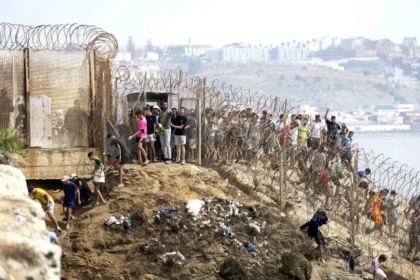
On July 30, the border between Morocco and the Spanish enclave of Ceuta effectively collapsed as tens of thousands of people crossed in a matter of hours. Spain’s interior minister later put the figure at around 72,000. Most returned to Morocco within hours, but thousands stayed in the city for weeks, often in difficult conditions.
Many in Spain blamed Rabat. Morocco has rejected accusations that it allowed or encouraged the crossings to put pressure on Madrid, and Moroccan sources pointed to criminal networks. Sánchez himself has said there is no proof of Moroccan responsibility and has praised Rabat’s cooperation in handling the crisis. On October 5, he dissolved parliament and called elections for November 29.
The candidates’ positions
PP leader Alberto Núñez Feijóo made Ceuta his first campaign stop and has said the city will be the first file on his cabinet table. In parliament in September, he said the July influx “came from Morocco” and was tolerated by Moroccan authorities, and he has said he would be ready to deploy the armed forces to protect the border if a new mass entry were expected. He proposes a new immigration law to speed up returns and wants all those who entered Ceuta irregularly sent back. At the same time, he has said Spain must maintain its relationship with Morocco.
Vox goes further. Its leader Santiago Abascal has accused Sánchez of being Morocco’s “servant”, and the party has pushed for immigration, Ceuta and Morocco to dominate the campaign. Left-wing parties are trying to shift the debate toward housing and the cost of living.
What the polls say
The first daily tracking poll of the campaign by Sigma Dos for El Mundo, with fieldwork from November 3 to 11, gives the PP 30.8% of the vote, the Socialist PSOE 25.3% and Vox 19.6%. On those numbers, PP and Vox would win between 189 and 202 of the 350 seats in Congress, above the 176 needed for a majority. A PP-Vox coalition would bring the hard right into a Spanish government for the first time since the end of the Franco era.
What is at stake for Morocco
Relations between Madrid and Rabat have been unusually close since 2022, when Sánchez’s government backed Morocco’s autonomy plan for Western Sahara. Cooperation on migration, security and trade has expanded, and the two countries are preparing to co-host the 2030 FIFA World Cup with Portugal. Spain is also Morocco’s largest trading partner.
A change of government would not automatically reverse that relationship, and Feijóo has stressed the importance of ties with Rabat. But the tone of the campaign points to a more confrontational approach on borders and migration, and it is unclear how a PP-led government, especially one depending on Vox, would handle the Western Sahara file or the status of Ceuta and Melilla, which Morocco claims.
The European dimension is also growing. In September, the European Parliament adopted a resolution expressing solidarity with the residents of Ceuta and Melilla and calling for stronger protection of the EU’s external borders, and a delegation of MEPs from its civil liberties committee was scheduled to visit Ceuta from November 16 to 18. Whatever the result on November 29, Ceuta has turned Spain-Morocco relations into a domestic political issue in Spain, and a European one.